Wednesday, February 8, 2012

REVIEW: Shades of Grey by Jasper Fforde


Shades of Grey 
by Jasper Fforde

“The safest course was actually the simplest-do nothing at all and hope everything turned out for the best. It wasn't a great plan, but it had the benefits of simplicity and a long tradition. ” 

Edward Russett lives in a future where everything is governed by color. "Something Happened" a long time ago that messed with everyone's vision. Now people can only see one color, and the color you see, and how much of it, determines your place in society, from the lowest Grey to the highest Purple. Nighttime is an empty time, as everyone has lost their night vision. It is socially important to marry within your color, or up-spectrum to either maintain or improve your social prospects. 

Everything is governed by the rules of "Our Munsell," a leader from centuries before when the "Something Happened." He had an "Epiphany" and brought order to chaos, regulating every aspect of the community, from high values (like politeness) to what people should wear on what occasion (for excursions into the wild, people must wear "Outdoor Adventure #9s). Rules cannot be changed. There is a spoon shortage because he forgot to include spoons in the list of utensils to be manufactured. Or he could have left it off on purpose. Munsell works in mysterious ways. 

The story follows Edward as he travels with his father to East Carmine to conduct a mandated chair census as punishment for a prank so he will develop some humility. He makes friends and enemies, and starts to uncover the dark secrets that serve as the basis for the society. 

Long synopsis, I know, but it is Jasper Fforde, and I am not even touching the tip of the iceberg on this one. Animals have barcodes. Most people die of Mildew or giant swan attack or balls of lightning. There is a place called High Saffron from which no one returns, but legend says has lots of color to harvest. Tip of the iceberg.

Happily, Fforde seems to have learned how to time-release information. His witty, intricate world-building is not as overwhelming as it is in the Thursday Next books and crops up at an appropriate time, with an explanation reasonably close behind it. 

The pacing was a little strange. The whole book takes place over the course of the week, but enough happens that you think he's had to have been there at least a month. At the same time, not much of "oh my god the society is horrible, and we need to do something about it" occurs until about the last 50 pages. 

I loved this book at first. Fforde gleefully plays with the reader's expectations. It made me happy to see that he couldn't resist literary references (a layover from Thursday Next and the Nursery Crime books: he includes a strange empty library, over-staffed by librarians with nothing to do (Munsell-regulated staffing rules). He even put in a few literary jokes here and there (list of approved sports includes "reeling and writhing" though no one knows what it is - Alice in Wonderland reference), and there is a memorial statue to Oz, though its meaning is lost to the citizens). They have "Leapbacks," where technology deemed too unnecessary or progressive is taken away... like light bulbs, or any car above a Model T. Same with books. Catch-22 is gone, legend says it was a very popular fishing book in a series. No one knows why Little Engine that Could was so subversive, nor what it was the little engine could do. It is Fforde at his comic best, an equal of Douglas Adams or Christoper Moore. 

However, the ending is very dark. In a book like this, you think it has two possible outcomes: 1) the main character reveals the evils of society and starts a revolution or 2) the main character discovers horrible things, but is too overpowered by society to effect change, and is absorbed back into it's rhythms or is killed. This one ends with a rather stomach-turning bastard child of the two. 

All I'm saying is that there better be a sequel where something satisfying happens. 

You might like this book if you liked:
A Dirty Job by Christopher Moore
The Fourth Bear by Jasper Fforde
Thursday Next: First Among Sequels by Jasper Fforde

Friday, January 27, 2012

REVIEW: Goliath by Scott Westerfeld


Goliath
by Scott Westerfeld

"Reality had no gears, and you never knew what surprises would come spinning out its chaos." 

Surprised to see me again so soon? Me too! I read this book in 3 days!

Goliath is the thrilling conclusion of the Leviathan/Bohemoth/Goliath steampunk WWI series. Goliath finds our intrepid team of Prince Alek and Deryn/Dylan still on the Leviathan, off on a secret mission to Russia to rescue an eccentric scientist, Nicola Tesla, who claims to have a weapon that will end the war.

This book basically covers the rest of the world: Book 1: Europe, Book 2: Ottoman Empire: Book 3: Russia, Japan, Mexico and the USA. While each country adds their odd quirks and flavor to the Clanker and Darwinist technology, they didn't have the depth and texture of Book 2's Ottoman culture. Granted, they only leapfrogged to each country, and couldn't stay too long. We get a nice historical figure cameo parade, though; we meet Tesla, William Randolph Hearst, Pancho Villa, and a few minor figures here and there.

This book was a lot less epic in scope than I expected. Spoiler alert: the war does not end. In fact, America is only just joining the war as the curtains come down on the trilogy. But I realized it is not the story of the war, it is the story of Alec and Deryn and their relationship, and that story ended very satisfactorily.

Alek finally discovers that Deryn is a girl, and the shock and betrayal and sulking, and eventual awkward reconciliation, tension, and intimacy are incredibly emotionally rewarding. Deryn's struggle with her growing feelings for Alek is much more compelling than other books I have read recently (see my review of Hunger Games if I ever get around to finishing them), because she doesn't spend hours moping and then never resolve anything. She thinks about it, basically says "Well, that sucks" and moves on. Or she does something about it. Or she ignores it and does her job. She's one tough chick. Yet, Westerfeld allows her moments of incredible vulnerability in this book, and it makes her and Alek's relationship that much more special that she allows her veneer to slip a little when they are alone together.

Alek also has to come to terms with his "destiny." He feels he is meant to end the war, since his family started it.  He backs Tesla, even though the inventor is bat-shit crazy, because Tesla claims he can end the war with Goliath. When Alek discovers the purpose of Goliath, however, he is caught between ending the war quickly at the cost of innocent lives, or letting the war drag on, perhaps at the cost of more.

The story weaves together their struggle between their duty to the war/ stations in life, and to each other. While the plot itself is a bit thin, the emotional payoff is fantastic. The two have grown so much since we first met them in Leviathan, and it kinda makes you proud. Well done them.

Oh, and read this book just for the perspicacious lorises, the mystery beasties we were introduced to in the 2nd book. They have some of the best lines in the series. Trust me.


All in all, a solid, clever, quick YA read.

My reviews of the rest of the series:
Leviathan by Scott Westerfeld
Behemoth by Scott Westerfeld

Tuesday, January 24, 2012

REVIEW: A Dirty Job by Christopher Moore


A Dirty Job
by Christopher Moore

"It was watching Madeline Alby eat cheese with every ounce of her being, like it was the first and best time, that made him realize he had never really tasted cheese, or crackers, or life. And he didn't want his daughter to live that way ... He wanted her to experience all the glorious cheese of life."

Charlie Asher is a Beta Male, with all the wonderful neuroses that implies. He is happily married to the clever, funny, steadying Rachel who balances out his panicked fidgeting with a calm, wry presence. That is... until she dies, and Charlie is shanghaied into becoming a Death Merchant, effectively a reaper, who collects the souls of the dead which are stored in objects, and helping them move to their next life. Oh, and he is now a single dad.

This is my favorite of all the Christopher Moore books I have read (Lamb and Fool). While along with Lamb, it has spiritual truth mixed in with its sharp, naughty humor, A Dirty Job also has heart, deep compassion, and a rich, full-bodied flavor... if that makes any sense. Lamb and Fool were based on established characters, whereas A Dirty Job is all Moore. He lets his devilish creativity out to play, and the love he puts in to every one of the people (and animals) of this book is palpable.

The first chapter is one of the most perfect pieces of writing I have ever read. If is heart-warming, witty, irreverent, shocking, and primal-screamingly tragic at the same time, and it sets the tone for the rest of the book. Moore makes you fall in love with Charlie and Rachel, and then smashes that relationship away from you in the blink of an eye.

The rest of the book is devoted to Charlie mourning his wife, discovering he is "a Death," and coming into his own as a snazzy-suit-wearing, sword-cane-wielding purveyor of ensouled objects, all while trying to raise a daughter (Sophie), fight rising evil, and placate the whirlwind of zany characters that inundate his life. While some of the characters are comically, and occasionally uncomfortably stereotypical (Ms. Ling and Ms. Korjev, Charlie's neighbors who look after Sophie and are referred to as the "great powers of Asia"), there are also characters like Inspector Rivera, a cop who has seen a lot of weird stuff, so takes things like Charlie throwing firecrackers in the sewer drains or trying to kill old ladies with cement blocks in stride, or the Emperor of San Fransisco, the homeless wanderer with the weight of the city on his shoulders, or Minty Fresh, the mint green suit wearing African American giant, or Lily, the goth chick who works in Charlie's second hand store. Or Sophie's hellhound babysitters. Or the triumvirate of spirit women called the Morrigan who live in the sewers and are trying to royally fuck with, and possibly eviscerate Charlie and all his friends.

This book is not perfect. It starts out with one kind of pacing, and then suddenly newborn Sophie has dialogue and she is five. The book spans a lot more time than expected. The story seems to be structured like a beaded necklace, with awesome bits strung together with "and then some stuff happened for a few years." Its not really a huge problem, just jarring at times.

The author also seems to lose his way towards the end, uncertain as to how to get to his resolution. There is a lot of driving around to different locations, as if the author didn't know where the final stand against evil would be, and some exposition monologing just when you expected the epic throw down. However, when it comes, it is plot-twisty (though a bit obvious) and satisfying.

If you like Clive Barker's Weaveworld, any Neil Gaiman, Terry Prachett (my review of Hogfather) or of course Christopher Moore (my review of Lamb), you will love this book.

Friday, January 13, 2012

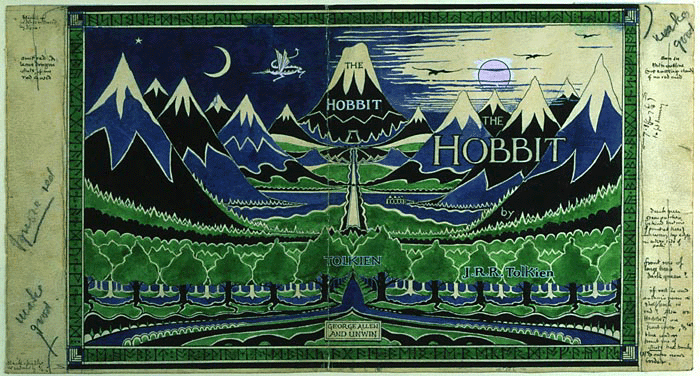
REVIEW: The Hobbit by J.R.R. Tolkien


The Hobbit
by J.R.R. Tolkien

"He was trembling with fear, but his little face was set and grim. Already he was a very different hobbit front he one that had run out without a pocket-handkerchief from Bag-End long ago. He had not had a pocket-handkerchief for ages. He loosened his dagger in its sheath, tightened his belt, and went on."

I was getting frustrated with Joe Abercrombie's The Heroes (which I am sure will appear on this blog in due course), so I put it down to read this old favorite. 

Bilbo Baggins is a comfortable, respectable hobbit, happy to wile away his days in his cozy hobbit hole and live an unremarkable life. Gandalf, however, has other plans and whisks Bilbo away on an adventure through the Misty Mountains and the dark Mirkwood, over the River Running to the Lonely Mountain with a group of surly dwarves, and the little hobbit is changed forever.

I have loved this book ever since my dad read it to me as a child. He would do all the voices and sing all the songs. I don't think I have read it since middle school, though, so it was a bit of a jarring experience to read it again at age 27, after having read and seen the Lord of the Rings and while waiting impatiently for the Hobbit movie to come out. It colored my experience a bit.

It took me a while to get back into the style of it. It is a child's story and thus views Middle Earth through an incredibly innocent lens. Gandalf is the uber-adult, who takes care of the hobbit and the dwarfs, and makes such statements like "I am such a great wizard, and even I was concerned for a moment." You know that if Gandalf is there things will turn out ok. It was hard to reconcile this Gandalf with the Gandalf in LOTR at times. The imminent danger of death is not there, as it was in LOTR. It is very much a "hobbit's holiday," where things get dangerous (or "uncomfortable" as Bilbo says), and there is a potential for death, but not like it was for Boromir, or Haldir, or Theodin or any of the thousands who were slaughtered in LOTR. This is the world Pre-Sauron, where when you went on adventures, it is a great surprise to encounter severe problems (as it was for the dwarves at the start of the journey). Characters do die, but it is not portrayed as a brutal waste, but as a noble and kingly end. 

It was also difficult to reconcile the Hobbit elves (merrymaking, singing and making jokes) with the elves of LOTR (serious, ethereal and rather dull). 

However, the meat of the story still gladdened my heart: the story of a silly gentleman hobbit who is thrust into a quest against his will and transforms into a brave, wise, and resourceful adventurer (though he still occasionally longs for his cozy hobbit hole). The encounter with Gollum was as creepy and clever as ever, though I still don't understand some of the riddles). I started to really get invested once the spiders hit (one of my favorite moments) and Bilbo comes into his own. The moments come fast and furious after that: the Elven King, Barrel-Rider, banter with Smaug, the Arkenstone, the dwarves bursting out of the mountain into battle,  the deaths of friends, the journey home and the auction and the epilogue. 

The language was a delicious blend of the poetry of the Viking Eddas and simple English country talk. Some of the phrases role rhythmically off your tongue, like "The Arkenstone of Thrain," or "Thorin Oakenshield." Sometimes they use high romantic language, and Tolkien translates it into plain English for the reader, which amused me greatly: "'We are sent from Dain son of Nain,' they said when questioned. 'We are hastening to our kinsmen in the Mountain, since we learned that the kingdom of old is renewed. But who are you that sit in the plain as foes before defended walls?' This, of course, in the polite and rather old-fashioned language of such occasions, meant simply: 'You have no business here. We are going on, so make way or we shall fight you.'"

I also enjoyed how he let the dwarves be grumpy. Often in modern culture there is a huge push to hide that you are out of sorts, or to get out of it as soon as possible; that it is a deficiency in yourself if you allow any negativity. Tolkien lets them sit in their grouchiness for a while, and not only is it allowed, it is natural and justified! They would scold the hobbit and sulk for a while if they had been scared for no reason, or if they had no food, or if they had spent a few days bobbing in barrels. And it was understood, allowed, and passed naturally when they had a good meal, or were left alone for a while. 

The Hobbit is always worth a re-read, and makes me very happy in this cold weather to go home to my cozy hobbit hole, eat a good meal, and drink tea in front of a hypothetical roaring fire. 


Friday, December 9, 2011

REVIEW: Mechanique: A Tale of the Circus Tresaulti


Mechanique: A Tale of the Circus Tresaulti
by GeneValentine


"Ladies and gentlemen," she calls. Her voice fills the air. It feels as if the tent grows to accommodate the words, the circle of benches pushing out and out, the tinny Panadrome swelling to an orchestra, the light softening and curling around the shadows, until all at once you are perched on a tiny wooden seat above a vast and glorious stage. The woman's arms are still thrown wide, and you realize she has not paused, that her voice alone has changed the air, and when she goes on, "Welcome to the Circus Tresaulti!" you applaud like your life depends on it, without knowing why.

The Circus Tresaulti has been traveling for a long time, watching wars waged, regimes fall, and new corrupt ones rise. Sometimes they come across a town that seems familiar, but it is an old ruin, so it couldn't have been the town they visited before, could it?

The performers have been with the show for an age (or maybe a few). There are some who come and go like mayflies, but others choose to be augmented by the Boss, and they stay forever. The Boss gives them new hollow bones (the aerialists) or massive gears in their back (the strong man), or, only once, a set of singing wings. They are tied together tighter than family, tighter than blood. They know every gesture, every molecule of each other; they hate it, they love it, and they would die for it.

I must admit I started out not liking this book. It felt like faded footage of a circus: you got to observe, but never touch, never delve. The narrator was uninteresting. Then, about halfway through the book,  shit hits the fan, when the government man comes to the circus. Suddenly, secrets that you kind of knew, but didn't really, explode in your face, and there are dark revelatory flashbacks and loyalties are tested to the breaking point.

The book feels very post-modern, switching perspectives from first to third person, or maybe you are still in the head of the first person but he happens to know everything in retrospect? Its confusing for a while, and then you just stop caring and go along for the ride.

Valentine is the master of the subtle essential detail. She will drop a tiny sentence at the end of a scene that changes the game completely, though you may not know it until a few chapters later.

For a while, the performers seem a bit crazy, like bitchy Elena who may or may not have let someone fall from the trapeze on purpose, the beautiful Winged Man who may or may not have committed suicide, Stenos the acrobat who hates his partner to the point of obsessive devotion, Bird, the ex-soldier, who will do anything to have the wings. But as you marinate in their lives, you begin to see why this all emotionally, if not intellectually, makes sense.

The most compelling character is that of the Boss. She (yes, she), is the ringmaster, the creator of the circus, the mother of all. Her word is law, and in many scenes she seems invincible, but the revelations of her vulnerability are the most resonant parts of the book.

And it has a slam bang, guns blazing, last-stand, everyone you loved is here for you but may die for you kind of ending. Makes me cry every time.

Its not set in any time period, or in all time periods, so I wouldn't call it steampunk, though for moments it has that feel. At other times, it seems like an ageless, more sympathetic Mother Courage and her Children.

I was lucky! This was a book I picked off the shelf for its cover as the library was closing.

Read this if you liked:
Dream of Perpetual Motion

Monday, November 7, 2011

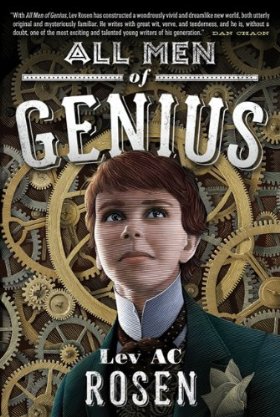
REVIEW: All Men of Genius by Lev AC Rosen


All Men of Genius
by Lev AC Rosen

"Furthermore, I don't recommend emulating the behavior of any of the characters contained within.
They're all quite mad.
The truth is, I have no idea what I'm talking about.
Except about love. We all know a little about that.
Or nothing at all."
- Author's Note

This book is a basically a steampunk mashup of Twelfth Night and The Importance of Being Earnest. Need I say more? Well, I will anyway.

Violet Adams is not your typical Victorian girl. She spends her spare time up to her elbows in grease and gears in her family's basement inventing wonderful things. She is serious and bullheaded, and frustrated that because she is a girl, she will never be recognized for her genius by her scientific peers. Her twin brother, Ashton, is the opposite: an easy-going poet and all around foppish cleverboots. 

She hatches a plan to dress as a boy so she can enter Illyria College, the best scientific school in the city. Along the way she makes friends and enemies (an excellently bitter and entitled Malcom Volio), falls in love, fights against an evil plot, is awesome and smart, and fights an incredible battle to win her place in the scientific community. 

I. LOVED. THIS. BOOK. It is crammed with characters and references to both Twelfth Night and Importance of Being Earnest, but it is not slavishly devoted to either story. You get themes, characters, delightful flavors, and sometimes direct quotes, but Rosen makes them his own. For example, Mariah from Twelfth Night is Miriam Issacs, a "Jewess" born in Persia, married and widowed in Paris, and then employed as governess to Cecily (Cecily/Olivia). Miriam's relationship with student Toby Belch warms my heart. Cecily is as naive and youthful as Cecily Cardew, and falls for Violet-dressed-as-a-boy a la Olivia. Violet herself (after a long struggle) falls for Earnest, Duke of Illyria. Another example: One of the Professors is named Bunburry, and he rather accident prone. 

Like Neverland, it is nicely crammed, and there is hardly any space between one reference, and another, but if you don't know either play, you can appreciate the book for its own merits. And if you do know both plays, you will not be ruined on the story. 

It sounds complicated, but it doesn't feel that way while you are reading it. Reading the book feels like surfing, where you ride the rhythms of each section, and switch to the next wave of text as it comes. It is easy and exciting, and flows really well. And then, like a video game, you collect the little gold coins of allusion as you ride. 

The 3rd person point of view slides just as easily. Each character, including all the minor ones, gets their moment (or more) of perspective. You get to look through the eyes of of the all main characters, of course, but then you have moments when you are in the brain of Lothario Prism, the aging professor, to get his unique perspective on the science faire set up at the Crystal Palace, or Fiona, the burlesque actress Violet hires to be her maid, and who ends up seducing Drew Pale (a still pitiful, but happier Andrew Aguecheek). 

I also loved Violet's character development. At the beginning she was brash and fearless because she was naive and young. As she matures, she hones those features into a genuine bravery and strength of character. She learns that femininity is not weakness, and she that she can be both a girl, and fully herself. 

The book is also chock full of imaginative, steampunky science, which for the most part I loved. However, biology class made me cringe a bit. The biology class's sole purpose is to experiment on animals. Rosen does have Jack Feste upset when he kills an animal in his experiment, but the idea of "improving" animals (giving ferrets bat wings, or switching animal's voice boxes), while it lead to comical outcomes, made me uncomfortable.

Other than that, this book was probably the best book I have read on a long time. It is not a heavy, weighty tome of genius, but it was clever, funny, engaging, exciting, and had wonderfully detailed characterization.

Books like this:
Leviathan, Behemoth and Goliath by Scott Westerfield

Tuesday, October 25, 2011

Unfinished Book: The Affinity Bridge


The Affinity Bridge
by George Mann

Ladies and Gentlemen, I am sorry to say this so early on in my blog, but I could not finish this book. I vowed to give it 100 pages before I gave up, and I did. However, I did learn a lot from reading it, especially about my own taste and style, so I thought I'd devote some time to it on the blog. 

The story takes place in steampunk Victorian London, where Sir Maurice Newberry (a paranormal investigator) and his new assistant Ms. Veronica Hobbes try to solve the mystery of the crashed airship and the glowing murderous bobby, while trying to avoid the zombie plague. This is a recipe for awesomeness, yes?

Alas, it does not fulfill its potential. First, the characters are incredibly flat. Sir Maurice is a good-natured, reserved middle-aged English gentlemen. He accepts a woman as his assistant and treats her as a (delicate and feminine) partner. He is extremely attentive to her. He has a problem with laudanum, which is probably his most interesting attribute. But there is absolutely no color or texture in his character, no unique voice.

Ms. Hobbes was even more disappointing. When I see boy/girl detective partners, I expect playful snarky banter. Maybe I've been spoiled on too many episodes of Castle, Warehouse 13...or really any other boy/ girl detective paring. I wanted it to be Emma Peel and John Steed. I got bland, restrained, grey, blah. For example, I have no idea why she was hired. Sir Maurice has complete confidence in her abilities, though all we saw her do in the first 100 pages was clean well, make tea, state the obvious (at which everyone gasps and sputters to hear such wisdom from a girl), and vomit at the sight of bodies. I would have loved to see some glimpse at the extraordinary, a reason why a woman would get that position, a reason why Sir. Maurice treats her like trusted friend only after a few days. They are quite touchy-feely too, and makes you think there are romantic flutterings, when that does not seem to be what the author intends. 

The style bothered me the most. It may be because I recognized a lot of my own flaws in his writing, but it got to the point where I got so annoyed by the frequent blunders, couldn't read any more. It was like being beaten to death with a swarm of cotton balls. 

1) Repetition: First, he repeats metaphors mere pages apart. For example, he describes a crashed airship as a beached, dead, half-rotted whale, and then a page away describes it as a dead ancient primordial beast (with the skin rotted in places, and the ribs exposed, etc). Second, he repeats information. For example, he mentions in a telegram to Newberry and Hobbes that 50 people were killed in the airship crash. When they are told the same information at the crash site, Ms. Hobbes gasps in surprise and horror. Third, he has a bad habit of describing the same action from two different POVs without adding anything new to it: He describes Ms. Hobbes pulling her cloak to her because she is thinking of the dead bodies from the airship, and a few lines later, he has Sir Maurice observe her pulling her cloak to her because he presumes she is thinking about the dead bodies from the airship. We know.

2) Word choice: "pucker up that resolve." Really? Not pluck? Pucker just sounds dirty. He also loves the phrase "reminiscent of..." when presenting a metaphor. And his metaphors often are not well-chosen either. He describes "an army" of men, which he clarifies a sentence later as "at least ten." Most of the time he sounds like a man with a limited vocabulary using a thesaurus. 

3) Violent Emotional Reactions: I believe this is not a character trait, but a style snaffoo. When Sir Maurice is introduced to a character, we get a description of that character, and a sudden declaration from Sir Maurice that he admires or loaths the character, without making it clear what was to admire or loathe.   He also has violent reactions to any opposition. When police or a clerk won't give him information -- they don't know who he is -- he gets very shocked and huffy, and waves his Crown credentials around, and then the peons go scurrying. It does not match with his fatherly academic demeanor, and makes the reader think he is a dick. 

4) Don't Tell Me, Show Me: My favorite writers are able to give you character by describing how a character picks up a pen. Alas, this book is Tell City. For example, there is a passage where the author illustrates Sir Maurice in his study. Mann tells about about the character's relationship with the room using cliches, his "haven" and "the one place he could relax, and feel free to become himself" (though I saw no difference between himself inside or outside the study). I would rather have seen his relationship with the study through the way Sir. Maurice interacted with it (entered it, threw things, flopped, argued with his housekeeper about keeping out, etc). Telling runs rampant throughout the book. 

5) "These do indeed 'seem' for they are actions that a man might play": Mann has a tricky POV. Sometimes he is in Sir Maurice's head, and other times he is in Veronica's head (not that it really makes any difference). However, sometimes he is in 3rd person omniscient, and still his characters "seem" or "look like" they are doing things. Why the hell can't they just do them? Whose eyes are we looking through that we are guessing? I do this all the time in my own writing, so I don't have to fully commit. COMMIT! It makes the writing stronger. Don't say "seem" unless there is some doubt about the action.  

I think George Mann desperately needed a good editor. 

Please take my review with a grain of salt, as I have not finished the book (and I feel it an extreme defect in  a mystery novel if I don't care what happens). Please, if anyone has finished the book, and feel that I have misrepresented something, let me know!