Showing posts with label children's books. Show all posts

Monday, May 19, 2014

REVIEW: Flora and Ulysses: The Illuminated Adventures


Flora and Ulysses: The Illuminated Adventures
by Kate DiCamillo

“Pascal," said Dr. Meescham, "had it that since it could not be proven whether God existed, one might as well believe that he did, because there was everything to gain by believing and nothing to lose. This is how it is for me. What do I lose if I choose to believe? Nothing!"

"Take this squirrel, for instance. Ulysses. Do I believe he can type poetry? Sure, I do believe it. There is much more beauty in the world if I believe such a thing is possible.” 

Flora is a cynic. She spends her days up in her room reading comics like The Amazing Incandesto, The Criminal Element, and Terrible Things Can Happen To You! just to make sure she is prepared for the worst. Her motto is "Do not hope. Observe." This way, she can protect herself. Her mother spends her time writing romance novels on their typewriter and she seems to love the shepherdess lamp in the hall more than Flora. Her parents separated, and her quiet father lives in an apartment complex near by. Flora has learned that life is full of disappointments. That is, until one day, when a squirrel gets sucked up in her neighbors vacuum. The incident gives the squirrel amazing powers of strength, comprehension, and the ability to fly and write poetry. As their friendship blooms, Flora begins to think with her heart, rather than her head, but will it just give her more pain in the long run?

This is a delightfully silly and odd book with a true heart. Flora's transformation from cynic to believer is a joy to watch. Ulysses' (the squirrel's) inner monologue made me smile each time we entered his head. He was so full of wonder at the world as he was now comprehending it that it moved him to write poetry and express his love for Flora. Her father's reawakening to wonder and self-expression due to Flora and the squirrel was probably my favorite part. There is an incredible cast of characters, from Tootie the poetry loving next door neighbor, to her nephew William Spiver who believes he is temporarily blind due to recent trauma, to Dr. Meescham, a doctor of philosophy who teachers Flora about lonesomeness and being open to possibilities.

The word play and repetition is delicious. The father always introduces himself, no matter what the situation. Flora pulls words from her books, like "Holy Bagumba" and "This malfeasance must be stopped," elevating Ulysses to the role of superhero. I think my favorite might be the recurring reference to a painting in Dr. Meescham's office of a squid with its tentacles around a small boat in a dark sea. Flora sees the squid as a villain, but Dr. Meescham explains that the squid is lonely because it might not see another of its kind for its lifetime. The image of the squid recurs in reference to Flora's lonely heart throughout the book: “Flora’s heart, the lonely, many-armed squid of it, flipped and flailed inside her.”

It is a joyful book with a great heart. I highly recommend it for those who feel they have lost their ability to believe.

Friday, May 16, 2014

REVIEW: The Firefly Letters by Margarita Engle


The Firefly Letters
by Margarita Engle

We go out at night 
to rescue fireflies.

Children catch the friendly cocuyos
and pull off their wings
or put them in bottles
to make little lamps
where the insects glow and fly
until they starve.

Women tie living cocuyos
onto their ruffled dresses as ornements
and girls weave them into their hair 
like flashing jewels.

Fredrika and I
feel like heroines in a story, 
following people around
buying captive fireflies
and setting them free.

A novel in verse, Engle tells the true story of Fredrika Bremer, a Swedish suffragette, who travels to Cuba to document life there at the turn of the century. She is given an African slave named Cecelia to translate for her. Fredrika's host family has a young girl named Elena who has never been outside her house and is strictly told what is and is not expected of a noble lady. The novel is structured into short poems from the perspective of Fredrika, Cecelia, Elena, and Cecilia's husband Beni, as they reveal the pleasures and darker underbelly of Cuba.

This was a delightful book. I had expected a bit more action, but the lyrical poetry was enchanting and I was taken on a lovely ride. It was fascinating to learn about Cuba at that time and see how the three women help each other to grow. It is an interesting exploration of slavery and captivity in all its forms.

REVIEW: Hold Fast by Blue Balliet


Hold Fast
by Blue Balliet

"Hold fast to dreams for if dreams go, life is a barren field covered with snow. hold fast to dreams for if dreams die, life is a broken winged bird that cannot fly." 
- Langston Hughes

They have always been four, Dashsumearlyjubie, a family that held tight to each other, loved each other, learned from each other and was happy. That is until Dash, the father, was hit by a truck and disappeared one snowy day. Summer, the mother, Early, the daughter, and Jubie, the young son, are distraught, knowing that their father who worked as a page at the Chicago Public Library was not the kind of father to walk away from them. Then one night, masked men break into their apartment with guns, steal all their books, and destroy their home. Forced to live in a shelter, Early takes it upon her self to solve the mystery of her father's disappearance and find them a new place to live. Guided by her father's favorite book, The First Book of Rhythms by Langston Hughes, she follows the sinister trail of betrayal and lies to find what is really going on while struggling to keep her family from falling apart.

This was a beautiful, poetic book that is absolutely in love with language. I was itching to read it out loud. The Pearl family loves words. They keep a book of new words that they discover and love. At the beginning of each book section is a word that has multiple definitions which encapsulate the next movement of the piece.

Towards the middle, I began to lose interest because not much was going on, but Balliet kept pulling me back in with the beautiful words, the strong bonds of love, the exploration of Langston's work that was the only thing that kept Early going, and the strong feeling of magic realism just in the corner of your eye. It is also a good introduction into the life of a homeless family, and I would probably read it to a class for both poetry and social justice.

A really beautiful book. I am going to pick up The First Book of Rhythms now.


Tuesday, December 17, 2013

REVIEW: Breadcrumbs by Anne Ursu


Breadcrumbs
by Anne Ursu

“A boy got a splinter in his eye, and his heart turned cold. Only two people noticed. One was a witch, and she took him for her own. The other was his best friend. And she went after him in ill-considered shoes, brave and completely unprepared.” 

Hazel has moved from a more progressive, creative school to a traditional school in a new neighborhood. She feels so out of place. All the things she enjoyed about learning are discouraged. Her only touchstone is her best friend Jack. They let their imaginations run wild, inventing stories and playing baseball as superheros who are not allowed to use their powers. However, one day, Jack gets something in his eye, and he is completely different. He is mean to Hazel and doesn't care about what they used to care about. And then he disappears. Everyone thinks he went to visit his aunt, but Hazel knows something is wrong. She knows he was stolen by the Snow Queen. She must embark on a mission, facing wolves, witches, and ice, to save her best friend... who might not want to be saved.

I thought I would like this book a lot more than I did. "The Snow Queen" is one of my favorite tales. I felt this book was a bit lackluster for several reasons. First, the Snow Queen is a metaphor and a story they make up, as well as a real, concrete, straight from the fairy tale being. It straddled the land of metaphor and the land of reality. I almost wish that it remained in the land of metaphor, and used the story of the Snow Queen in a magic realism sense to depict the loss of a friend. But it wheels completely into the realm of fantasy, at times being slavishly loyal to the original, and at other times going strangely off the rails.

I did enjoy her constant allusions to other books like Lord of the Rings, Wrinkle in Time, Chronicles of Narnia, the Golden Compass, but it was a "huh I am in on the joke" enjoyment, rather than enjoying them for their artistic purpose. More than that, I liked her use of other Anderson fairy tales woven into Hazel's strange adventures in the snowy forest. The woods were mysterious and dream-like; unpredictable threats could jump out at any moment disguised as goodness. It made the journey disjointed and disorienting.

The ending was also unsatisfying, not because it is ambiguous, which it is, but because there are several elements left unexplained, like why the Snow Queen gave Jack the puzzle and what would have happened had he completed it.

Throughout, the book had a rather condescending tone towards science and "grown up things." It rankled me a bit, because science can go hand in hand with imagination, it is not the enemy. Hazel railed against anyone she perceived not to have an imagination which made me dislike her a little.

I appreciated Ursu's playful language, however, and the fact that she did not make the Snow Queen a villain in the traditional sense. There were several ancillary characters like Martin, Hazel's friend's imaginative uncle, who were delightful to read, if a bit flat.

It is a lovely story about how friendships change over time, but I felt it could have been stronger. I know several friends who enjoyed it, however, so perhaps I have missed something.

Saturday, November 9, 2013

REVIEW: Skulduggery Pleasant by Derek Landy


Skulduggery Pleasant
by Derek Landy

“Her parents wanted her to find her own way in life. That’s what they’d said countless times in the past. Of course, they’d been referring to school subjects and college applications and job prospects. Presumably, at no stage did they factor living skeletons and magic underworlds into their considerations. If they had, their advice would probably have been very different.” 

When Stephanie's eccentric uncle suddenly dies, she meets someone rather mysterious at the reading of the will. Skulduggery Pleasant, her uncle's old friend, covers himself with a coat, scarf, had and dark glasses. When Stephanie is attacked by a terrifying man, Skulduggery reveals himself to be a walking, talking skeleton, an ancient sorcerer whose lost his life fighting the forces of evil, and pulled himself back together to finish him off. In the last few hundred years, he has become a wisecracking detective. Together, he and Stephanie must face a new threat, and stop a villain from destroying the world.

This book was absolutely clever and charming. While the plot was rather simple and conventional for the genre, and the villain was one dimensional, but the meat of the story is Skulduggery and Stephanie's relationship. Skulduggery is witty and silly fun on his own, but together with Stephanie the banter and chemistry is electric. They bat scenes back and forth like a tennis ball, matching each other in wit, humor and grit.

I loved Stephanie's slow assimilation into the magic culture. Once she knows it exists, she must choose to turn back to her old life, or plunge forward wholeheartedly into the danger and the dark. As she steps further and further in, her understanding of the very real threats that face them grow and her continuous determination to help Skulduggery is heartening. In this world, people have three names: the secret name they are born with, the name they are given by their parents, and the third name that they choose. That third name protects a sorcerer from using their other two names to control them, and it is usually deliciously descriptive. The moment Stephanie chooses her name was so powerful, I got shivers.

It bothered me how much Stephanie was on the sidelines of the fighting, either hurt or watching. However, she is 12 and a magic noob, so it makes sense that Skulduggery does most of the ass-kicking. Tanith Lee, a female swordslinger who joins up with them, gives us ample badassery on her own. And Landy allows her to giggle with Stephanie, which makes me so happy. No stoic, cardboard, humorless fighter chicks in this book!

I also appreciated Stephanie's family life. Usually in stories like this, the protagonist's family abuses them, or is apathetic, or is dead. Stephanie's family cares! Her dad is absolutely lovely, and has one of the most touching scenes in the book. You worry that in the sequels, Stephanie is going to break his heart.

A fun and fast juvenile read. I did wish it was more of a magical detective story, and less of an epic battle of good vs evil, but it was a joy to sit in the Bentley with Skulduggery and Stephanie and listen to them talk. I look forward to see where this series goes (there are 8 of them!)

Sunday, September 22, 2013

REVIEW: The Wizard of Oz by L. Frank Baum


The Wizard of Oz
by L. Frank Baum 
“I cannot understand why you should wish to leave this beautiful country and go back to the dry, gray place you call Kansas."
"That is because you have no brains," answered the girl. "No matter how dreary and gray our homes are, we people of flesh and blood would rather live there than in any other country, be it ever so beautiful. There is no place like home." 
The Scarecrow sighed.
"Of course I cannot understand it," he said. "If your heads were stuffed with straw, like mine, you would probably all live in beautiful places, and then Kansas would have no people at all. It is fortunate for Kansas that you have brains.” 

Dorothy lives in Kansas with her uncle and aunt. It is a grey little farm on a grey little plain. One day a tornado swoops down and takes Dorothy and the house up into the sky and down again, landing in the Land of Oz on top of the Wicked Witch of the East. Dorothy and her new friends the Scarecrow, the Tin Woodsman and the Lion travel through perils to the Emerald City to each receive what they most desire from the great and terrible Wizard of Oz. But will Oz's price be too much for them to pay?

Please do not read this if you are a part of my book club! This is my first time reading the books. I have seen the movie several times, and I have vague memories of reading Oz stories in picture book form, but I never had all of them, and the ones that stood out were the visit to Oz, the china town and the Hammer Heads. I had never read it all the way through.

I love it! The style is so charming. I shouldn't say that it reminds me of The Girl Who Circumnavigated Fairy Land in a Ship of her Own Making, it should be the other way around, but I hadn't read Oz yet!

I loved that the Scarecrow, the Tin Woodsman and the Lion weren't just Dorothy's backup dancers. They each had their own very specific talents -- ironically the exact talents they thought they lacked. On every adventure, the Scarecrow would come up with the plan, the Tin Woodsman built or used a tool to help with the plan, and the Lion had to complete the scary task. They used teamwork to solve problems and they could not have accomplished any part of their journey without the other. There were very few moments like that in the movie where they separately shone as part of the whole.

Dorothy, while still a child, is much more sensible than the Dorothy in the movie. As much as I love Judy Garland, she is very much the damsel in distress. Dorothy keeps a close eye on the food supply for the journey, and keeps her head down when she needs to. She deals with the supposed death or loss of her companions multiple times, and she handles herself in Oz with maturity. When the witch takes her prisoner, she obeys and comforts the lion (one of the more touching moments of the book for me). The end rescue happens in reverse from the movie. Dorothy has had enough and in a fit of frustration throws water on the witch and melts her (rather than as a desperate impulse in the movie). She rescues the lion and then goes to rescue the Tin Woodsman and the Scarecrow.

I was so shocked at the violence in this book. The Tin Woodsman kills a lot of animals with his ax. But I did appreciate how Baum handled Oz' request for Dorothy, a little girl, to kill the Wicked Witch of the West. She cries and states that she cannot kill someone willingly. I felt this was missing in the movie, the full weight of asking a child to kill someone.

I did feel that the adventures post Oz's departure were a bit too much. The movie handled it nicely, having Glinda appear at the balloon launch. Perhaps it was because I was used to the movie's ending that I didn't fully grasp the trajectory of this story.

I missed the parallels between farm life and the Land of Oz to show that she still carries some Oz with her at home. It makes me wonder if she will be as happy as she claims in the grey land of Kansas. And you do wonder, after the 100th time they repeat the brains, heart, courage, home mantra...what did Toto want?

I did love the book, however, and I will definitely put it on my shelf of classics I will read to my children, along with Peter Pan and the Secret Garden.


Friday, May 31, 2013

REVIEW: Fever 1793 by Laurie Halse Anderson


Fever 1793
by Laurie Halse Anderson

“What did it feel like to die? Was it a peaceful sleep? Some thought it was full of either trumpet-blowing angels or angry devils. Perhaps I was already dead.” 

Mattie is a 14 year old girl who helps her mother run a coffeehouse in 1793 Philadelphia, the then capital of the United States and a bustling metropolis. Mattie is your typical teenager, sleeping late, grumbling about chores, crushing on the painter's apprentice down the block. There is faint news of a minor fever causing a few deaths in the city, but no one is really worried. Suddenly, the death toll skyrockets and Mattie finds herself struggling alone in an almost deserted city filled with the sick, dying, and desperate. She must draw upon every ounce of strength she has to survive the terrible plague and save those she loves.

This is another book that went so fast I didn't take any notes. It has a slow start, but I feel all plague or apocalypse books do. You don't want to hear about going to the market, you want to get to the DEATH! And once you get there, the story really picks up. There is danger and despair and loads of horrifying situations, and Mattie must rise up out of her slumpy lazy teenagerness to do what needs to be done. 

The grandfather is a refreshing and excellent character. He is bombastic and strong, friends with everyone, cheerful, silly and brave. While many of the other characters seemed like tropes, Captain William Farnsworth Cook was a delight!

I was happy that this book touched a little on every significant aspect of the Yellow Fever Epidemic of 1793: everyone fleeing the town, people stopped from entering other towns, Bush Hill, the Free African Society, the food shortage, the looters, the debate between doctors, the newspapers, the lack of government. Mattie gets to experience all of those up close and personal. 

Compared to other plague books, it is a bit mild, but it is the first juvenile fiction plague book I have read, so it is certainly a dark kids book! A nice, fast, apocolypsey read with more of a happy ending than most plague books get.

Books Like This
Company of Liars by Karen Maitland
The Doomsday Book by Connie Willis

I'm apparently a sucker for a good plague book. 

Friday, March 29, 2013

REVIEW: The Wee Free Men by Terry Pratchett


The Wee Free Men
by Terry Pratchett

"All witches are selfish, the Queen had said. But Tiffany's Third Thoughts said: Then turn selfishness into a weapon! Make all things yours! Make other lives and dreams and hopes yours! Protect them! Save them! Bring them into the sheepfold! Walk the gale for them! Keep away the wolf! My dreams! My brother! My family! My land! My world! How dare you try to take these things because they are mine! I have a duty!"

Tiffany Aching wants to be a witch. She is a girl from a shepherding family on a land unkind to witches, but she pays that no mind. And when the queen of the fairies steals her brother, she must summon up every inch of witchiness in her to handle the tiny Nac Mac Feegles, nagivate fairyland, and rescue him. 

This book was supposed to be a palate cleanser after the intensity of Company of Liars, and but alas the taste jarred a little. When I began to read it, it felt like fluff. The Nac Mac Feegles were silly, but unremarkable, and fairyland itself, though dangerous, was forgettable.

However, Tiffany Aching herself is a badass. I believe she might be my favorite female Prachett character to date. She does not have crazy fighting skills like many of the "strong female characters" in books these days (aside from walloping monsters with a frying pan). She has sense. And perseverance. And a deep connection to her roots. She is my kind of gal.

When battling with the queen, she must struggle with her own self-worth, her place in a vast universe, whether everything she ever thought about herself is wrong. It feels like the slippery slope of depression that I feel we have all struggled with. But thanks to her strong roots, she comes out on top. (And made me cry.)

The best parts of the book describe Tiffany's relationship with her grandmother, Granny Aching. Granny Aching is an old shepherding woman with two dogs, Thunder and Lightning. She tramps all over the hills in her giant boots in any weather, saving lost sheep and birthing lambs. She quietly and wisely protects the town and it's inhabitants from any wrong doing. She has died before the book begins, but it is from her lingering presence and her memory that Tiffany draws strength. She takes up the mantle of her grandmother to protect  what is hers. They are the kind of heroines I like to see, and I kind of want to be Granny Aching.

Other books like this:
Equal Rites by Terry Prachett


Tuesday, February 26, 2013

REVIEW: The Girl Who Fell Beneath Fairyland and Led the Revels There


The Girl Who Fell Beneath Fairyland and Led the Revels There
by Catherynne M. Valente

“She did not know yet how sometimes people keep parts of themselves hidden and secret, sometimes wicked and unkind parts, but often brave or wild or colorful parts, cunning or powerful or even marvelous, beautiful parts, just locked up away at the bottom of their hearts. They do this because they are afraid of the world and of being stared at, or relied upon to do feats of bravery or boldness. And all of those brave and wild and cunning and marvelous and beautiful parts they hid away and left in the dark to grow strange mushrooms—and yes, sometimes those wicked and unkind parts, too—end up in their shadow.” 

September once went to Fairyland. She went on a quest, and lost her heart, and saved Fairyland from the evil Marquess. Now she is back home in Wisconsin, waiting for the day when her chance will come again. When it finally does, September returns to a Fairyland very unlike the one she left. And it seems to be mostly her fault. The shadow that she sold in Fairyland in return for a girl's life has taken over Fairyland-Below and begins to steal the shadows of those people above. The shadows hold the darker, more passionate, hidden desires of the bearer, and most of the magic as well. Fairyland is being drained of magic as September's shadow, The Hollow Queen, Halloween, "frees" the shadow people and builds up her kingdom below.

Last time, September was a heartless child. She was selfish, in the unapologetic way children are selfish, and her adversaries are external. She creates a boat out of her own clothes and hair and kills a fish with her bare hands. She wrestles her best friend to get a wish. She defeats a girl who is very like herself, or who she could have been. This time, September is older. She has a growing heart, as the book says, as she enters her early teens. Her adventures are internal, examining the idea of relationships through the eyes of deer people who see marriage as hunting and slavery. She struggles with shadows of friends she thought she knew. She wants to find the thing she is supposed to do with her life. She feels she has lost the wilder parts of herself since she has lost her shadow, but she equated it with growing older and more sensible. While the obstacles she faces are quieter and subtler than those in the first book, they touch the heart of one who feels she has lost her wildness from growing up.

Again, Valente creates a glorious world, this time Fairyland-Below. The shadow people, the Goblin Market, the Vicereine of Coffee and the Duke of TeaTime, the Forgetful Sea, the kangaroo-like miners who wear memories as a necklace, the Onion Man, the Prince sleeping at the bottom of the world, Quiet Magic (which I want to master), and the chilling, yet sad Alleyman who is responsible for stealing shadows for the Hallow Queen.

And as always September's lessons ring true for the reader, wisdom is dropped like breadcrumbs. Here are a few of my favorites:

- “For there are two kinds of forgiveness in the world: the one you practice because everything really is all right, and what went before is mended. The other kind of forgiveness you practice because someone needs desperately to be forgiven, or because you need just as badly to forgive them, for a heart can grab hold of old wounds and go sour as milk over them.”


- “I’m a monster,” said the shadow of the Marquess suddenly. “Everyone says so.”

The Minotaur glanced up at her. “So are we all, dear,” said the Minotaur kindly. “The thing to decide is what kind of monster to be. The kind who builds towns or the kind who breaks them.”

- “For though, as we have said, all children are heartless, this is not precisely true of teenagers. Teenage hearts are raw and new, fast and fierce, and they do not know their own strength. Neither do they know reason or restraint, and if you want to know the truth, a goodly number of grown-up hearts never learn it.”


- “Because it's my fault, you see. I did it. And you must always clean up your own messes, even when your messes look just like you and curtsy very viciously when what they mean is, I am going to make trouble forever and ever.”

- “Do you suppose you will look the same when you are an old woman as you do now? Most folk have three faces—the face they get when they’re children, the face they own when they’re grown, and the face they’ve earned when they’re old. But when you live as long as I have, you get many more. I look nothing like I did when I was a wee thing of thirteen. You get the face you build your whole life, with work and loving and grieving and laughing and frowning.”

Books Like This:
The Girl Who Circumnavigated Fairyland in a Ship of Her Own Making by Catherynne M. Valente
Un Lun Dun by China Mieville


Friday, November 16, 2012

REVIEW: An American Plague: The True and Terrifying Story of the Yellow Fever Epidemic of 1793 by Jim Murphy


An American Plague: The True and Terrifying Story of the Yellow Fever Epidemic of 1793
by Jim Murphy

I absolutely loved this book. I was shocked that it was for kids! It was so gory and psychologically scary, and utterly compelling and informative. I definitely recommend it for people who love zombie plague stories. Or the 1700s. Or both!

This book tells the story of the 1793 yellow fever epidemic in Philadelphia. It starts out slow, listing one death, then several in a boarding house. Then, it spreads down the street and to other portions of the neighborhood until the entire city is infected. It chronicles the panic, how people left the city in droves, and abandoned family members. It describes in detail the horrifying symptoms (complete with illustrations), including vomiting black blood and bile. And it tells of the heroic efforts of those who stayed in the city to help, which to me was the most interesting part of the book: the survival efforts, what happens when government breaks down, the unlikely heroes. It concludes with the sociological aftermath, those who wished to forget the plague, those who pointed fingers, those who had to defend their actions. As an afterward, it tells of the discovery of the causes of yellow fever a century later, and a vaccine in the mid 20th century. It ends with a warning that there has been no recent vaccine for yellow fever, and if it reemerges, we would be almost powerless to stop it. Upbeat ending for a children’s book, huh?

And that is exactly why I loved it. I enjoy kids books that don’t pull punches. They tell it like it is. I feel that what kids fear most is the fear of the unknown. The things parents are whispering about, but won’t tell them straight up. The monster in the dark that you can’t see. I feel that adults are this way too. Once you know what something is, once you can name it, once you know how to fight it, it loses some of it’s power.

This book is not only compelling, but it is highly informative. Jim Murphy did extensive research into primary sources, including letters, diaries and personal accounts of those who were there. Because of this, he was able to build a very intimate and highly descriptive narrative without embellishing with fiction. It does what the best nonfiction does: place you there in the dirty, quiet street, watching another cart full of dead bodies creak by. You feel you know the historical figures personally.

I would recommend this book to my adult friends too! Nowhere in this book did I think for a moment that it was “dumbed down” for children. I think it is comparable to John Adams by David McCollough (though a lot shorter) or Devil and the White City by Erik Larson (but with less speculation)!

If you want a quick, informative, highly disturbing glimpse into a moment of real life in the 1700s, this is the book for you!

I recommend this book if you liked:
Devil and the White City by Erik Larson
Doomsday Book by Connie Willis

Sunday, November 4, 2012

REVIEW: Okay for Now by Gary Schmidt


 Ok For Now
By Gary D. Schmidt

"I came over to the table to see how come it was the only lousy thing in the whole lousy room. 
And right away, I knew why. 
Underneath the glass was this book. A huge book. A huge, huge book. It's pages were longer than a good-size baseball bat. I'm not lying. And on the whole page, there was only one picture. Of a bird.
I couldn't take my eyes off it. 
He was all alone, and he looked like he was falling out of the sky and into this cold green sea. His wings were back, his tail feathers were back, and his neck was pulled around as if he were trying to turn but couldn't. His eye was round and bright and afraid, and his beak was open a little bit, probably because he was trying to suck in some air before he crashed into the water. The sky around him was dark, like the air was too heavy to fly in.
This bird was falling and there wasn't a single thing in the world that cared at all."

This is the story of how you make a bully. Or how you stop one from being made. It is about the boxes we create, and how we should break them down. How if you expect a boy to be a thug, he will be that. If you expect him to do great things, he will.

Doug Swieteck’s dad lost his job, so they had to move to “stupid Marysvale” away from his friends and into a tiny house which he calls The Dump. Doug feels like everyone in town looks at him like he doesn't belong. His father drunkenly rails against his new boss and the unfairness of life, his older brother is off fighting in Vietnam, his middle brother persecutes him, and his mother with the beautiful smile smiles less and less. Doug has secrets that he is trying to hide, and, more and more, he finds himself talking like his older brother, Lucas,  when Lucas is being a jerk. That is until one person trusts him. One person sees him as not just a “skinny thug.” Through this, he is introduced to the pictures in James Audubon’s Birds of America and his life is forever changed.

This book is a companion book to The Wednesday Wars, and I think that, through this book, Gary Schmidt perfected what he was trying to do with the first book. Doug is at a much lower place than Holling, and he has much further to go. He is trapped in his own pain and defensiveness. Then, he meets Lil Spicer, who trusts him with her bike, not naively, but as a test of friendship. One person believes in him. Then two: Mr. Powell, the librarian, who shows him how to draw the birds he is so enchanted by. Then, each person on his grocery delivery route. But then as soon as everything gets good, his brother is suspected of stealing, and Doug is shunned and belittled by neighbors, teachers, and classmates. He starts to do bad in school, and act out. It is amazing how, like Schmidt said with The Wednesday Wars, we behave how everyone expects us to behave. The question is who will exert more influence over Doug: those who think he is a thug who will never amount to anything, or those who see his goodness.

Doug’s relationship with the birds was incredibly powerful. I was surprised. I never liked Audubon’s birds, but it took Doug’s eyes for me to see the beauty and the terror of them. I had to keep looking back at the pictures (which were used as chapter headings) to see if the picture really showed what Doug said, and sure enough, they did. And his interpretation of the picture changed over time. Events in his life shed new light on the pictures and their meaning.

Through his new friendships and his relationship with the pictures, Doug struggles to become more than is expected of him, striving to change himself and his life. He begins to topple the cages that hold him and his family prisoner.

Schmidt writes with beautiful symmetry, rhythm, and symbolism, and we begin to see that those blurry archetypes we see are not the whole picture at all. Nameless characters become named. People realize they are wrong. Doors open, hands are extended. People try. Not everything ends up ok; the final chapter is heart-wrenchingly open ended. But again, Schmidt has written a book that is a must read for any kid who feels trapped by expectation, or any adult who has become set in their views. 

I loved this book especially because Doug's attitude often reminds me of me; muttering about the stupid people in the stupid town. Seeing the worst in people because I am in a bad mood. Spreading my hurt around. Many people think that becoming a bully is something that comes from very specific circumstances, but the seed is inside all of us. I also saw myself in the townsfolk who judged Doug on the actions of his brother. I find myself writing someone off because of something I heard. This book encouraged me to open up more, and find the good in people in every moment, even if I am having a sucky day. 

Damn good book, even better than Wednesday Wars, and one I will buy.

The Arctic Tern, by John Audubon (the image Doug describes above):

REVIEW: The Wednesday Wars by Gary D. Schmidt


The Wednesday Wars
By Gary Schmidt

After we closed the books, Mrs. Baker asked me to discuss the character of Shylock.
 "He isn't really a villain," I said, "is he?"
"No," said Ms. Baker, "he isn't."
"He's more like someone who wants..."
"Who wants what, Mr. Hoodhood?"
"Someone who wants to become who he's supposed to be," I said.
Mrs. Baker considered that. "And why couldn't he?" she asked.
"Because they wouldn't let him. They decided he had to be a certain way, and he was trapped. He couldn't be anything except for what he was," I said.
"And that is why they call it a tragedy," said Mrs. Baker.  

The Wednesday Wars is about Holling Hoodhood, the Son Who Is Going To Inherit Hoodhood and Associates Architects Firm. He lives in the Perfect House, right in the middle of the town, where he is not allowed to go into the living room, and everything is covered in plastic. His life is set out for him by his forceful father, who makes every decision in his life based on if it will help advance his career. Until one day when his teacher, Ms. Baker, begins an independent study session with him, exploring the works of William Shakespeare. He then begins to wonder who it is he will become.

This book was amazing! Schmidt’s style is intricate and clear as a bell. Holling’s life starts out very small, mostly petty school troubles. He sees things through a narrow lens: “My teacher hates me.” However, as soon as he starts reading Shakespeare, his world is gradually widened. He sees other people’s point of view, and he gets a glimpse into lives that are not his own. He starts memorizing passages, and using Shakespeare’s words in every day speech. He begins to see that his father might not be the man he wanted to be. That there are things worth fighting for. That there are many sides to a question.

And the beautiful thing is that it doesn't happen through one brief training montage and he understands Shakespeare and life all at once. He reads one play at a time throughout the year, and each play reflects what is going on in his busy life. When he is dealing with love, he is reading Romeo and Juliet. When he is dealing with his father, he is reading Hamlet. When he is confronting a bully, he is reading Macbeth. While none of the stories really have clever exact parallels like so many of the YA Shakespeare lit painfully does, his knowledge of the work sheds a new light on his life, as Shakespeare should.

Since Holling begins to see the world differently, he starts to make different choices. Bolder ones. Riskier ones. Life-affirming ones. He begins to stand up for what he believes in. He stands up against his father, and he finds himself. And the brilliant thing is, he does it as a middle school boy.

This book touched me deeply, not only for the transformative power of Shakespeare (which my mother taught me in middle school), but because of the relationship between Holling and his older sister Heather. I have a younger brother who is often much smarter than me in many ways, and whom I can count on to take care of me like Holling did.

I highly recommend this for anyone trying to show kids the power of Shakespeare, and any adult who knows the power of Shakespeare and needs to remember what it was like to be a kid again and to choose for yourself.

Here is my friend Drown My Books' review of the book!

Monday, May 14, 2012

REVIEW: Un Lun Dun by China Mieville


Un Lun Dun
by China Mieville

"'There it was in the index. "Shwazzy, Sidekicks of the.'' Below that were subheadings, each with a single page reference. 'Clever One,' she read. 'Funny One.' 

'Look...' the book said. 'It's just terminology. Sometimes these old prophecies are written in, you know, unfortunate ways...'

'Was it Kath who was supposed to be the clever one?' Deeba said. She thought about how she and Zanna had become friends. 'So... I'm the funny one? I'm the funny sidekick?'

'But, but, but,' the book said, flustered. 'What about Digby? What about Ron and Robin? There's no shame in -'

Deeba dropped the book and walked away. It yelped as it hit the pavement."

Deeba has noticed something strange about her best friend Zanna. There was a picture of her face in the clouds. Animals behave strangely around her. Someone spray painted "Zanna forever!" on the wall. When Zanna and Deeba follow a strangely animated umbrella one night, they leave London and enter Un Lun Dun where Zanna is proclaimed "the Shwazzy": the Chosen One who will help save their city from the Smog. Only things don't happen exactly as they were prophesied and Deeba has to take on her friend's mantle to save the city she has come to love.

This book was pretty insane. And awesome. It took me a while to get used to the world; trash with a life of it's own, city bus airships, men with pins in their heads and clothes of books, houses with forests in it, a man who is a bird with a human body as it's vehicle, "binjas" (trash can ninjas), bookaneers (librarian adventurers), the Umbrellissimo (the man who controls the broken umbrellas that find their way to Un Lun Dun). It helped as soon as I started picturing it animated like a Studio Gibli film.

I loved the way it played with the idea of choice and free will, of prophecy and how it limits us. How those who were not supposed to do things can just say "fuck it" and do them because they need to be done.

This is another juvenile fiction book that does not coddle the reader in any way shape or form. Mieville paints, waltzes and plays chess with words. It doesn't matter that a word is not supposed to be in the vocabulary of a child. There is an incredible sequence with Mr. Speaker, the leader of words, who speaks and Utterlings appear to do his bidding. Deeba cleverly banters with him that words do not always mean what we want and turns his words against him.

Deeba is an amazing heroine. First, she has brown skin, which I am sorry to say is rare in science fiction and fantasy. I was so happy to see a non-white heroine! Second, she is urban London, lower class, and speaks in London slang. Another anomaly in sci fi/ fantasy. Third, she is clever as all get out. She outwits and logics (or un-logics) her way around Un Lun Dun, learning the rules, using them, and breaking them as she sees fit. She goes from being a side kick who just wants to go home to a true heroine and full-blooded citizen of Un Lun Dun.

Yet another kickass heroine who must lead her troops into battle, deal with losses, make mistakes, and outwit terrible enemies. And in the end, when she must choose between Un Lun Dun, and real London, she turns convention on its head!

And I must say, the epilogue is one of those pump-your-fist-in-the-air-yelling-WOOO! moments. Damn, it's a fun ride.

REVIEW: The Girl Who Circumnavigated Fairy Land in a Ship of her Own Making by Catherynne M. Vanente


The Girl Who Circumnavigated Fairyland in a Ship of her Own Making
by Catherynne M. Valente

“There must be blood, the girl thought. There must always be blood. The Green Wind said that, so it must be true. It will be all hard and bloody, but there will be wonders, too, or else why bring me here at all? And it's the wonders I'm after, even if I have to bleed for them.”

September is a heartless girl, bored of her life, fed up with her mom who works in a factory all the time, and with her dad who left for war. So, when the Green Wind comes to abduct her to Fairyland, she doesn't even say goodbye, or leave a note. She must do favors for witches, befriend a wyverary (a wyvern whose father was a library), outwit the evil Marquess, and, as the title implies, circumnavigate fairy land after she looses her shadow and her heart.

This was an exceptional book, even more exceptional that it was juvenile fiction. It did not pull punches, either emotionally, complex-ily (if that is a word... meaning that it did not paint the world in black and white), and vocabularically.

It reads as a modern day Alice in Wonderland. September is just as curious, just as impertinent, and just as heartless as Alice, and she meets strange and fantastic things, like the herds of bicycles that roam the land, or the half-people who can only speak in complete sentences when joined together, discarded furniture that takes on a life of its own when it is 100 years old, or the land of Autumn.

While Alice simply wanders and has things happen to her, however, September struggles with morality in a morally grey world (does she aquiess to the evil queen to save her friends? Is the evil queen very different from herself?). There is a wonderful theme of what it is to be chosen and what it is to make a choice.

Early in the journey, she is given the choice to loose her way, lose her mind, or loose her heart. Since she was heartless, she chose to loose her heart. She managed quite well until she grew to deeply care for the friends she made. When she looses them, all hell breaks loose, and you can see what a twelve-year-old girl is really capable of.

This is not pretty Narnia adventure hardship. September must make a raft using her clothes and her hair so she stands naked and shorn against the elements. She bludgeons a fish to death out of desperation, and nearly die horribly several times to get where she needs to go, and even then, she has not faced the worst.

She is the embodiment of badass heroine who does what needs to be done and sacrifices what she has to to save the ones she loves.

It also make an incredible statement about regulation. The marquess has started to bring over rules and regulations to Fairyland to make it "safe" for children who cross over. But that is not the point of Fairyland. It must be dangerous and hard, so the children can emerge strong and confidant and brave. Same thing could be said with a lot of things in our world, including regulation of books and education.

I recommend this to everyone!


There are so many good quotes, I have to add this one at the bottom:

“When you are born,” the golem said softly, “your courage is new and clean. You are brave enough for anything: crawling off of staircases, saying your first words without fearing that someone will think you are foolish, putting strange things in your mouth. But as you get older, your courage attracts gunk, and crusty things, and dirt, and fear, and knowing how bad things can get and what pain feels like. By the time you’re half-grown, your courage barely moves at all, it’s so grunged up with living. So every once in awhile, you have to scrub it up and get the works going, or else you’ll never be brave again.” 

Saturday, March 31, 2012

REVIEW: A Tale Dark and Grimm by Adam Gidwitz


A Tale Dark and Grimm
by Adam Gidwitz


“You see, Hansel and Gretel don’t just show up at the end of this story. 
They show up. 
And then they get their heads cut off. 
Just thought you’d like to know.”

It is true. Hansel and Gretel get their heads chopped off. And then their story begins. Hansel and Gretel were the son and daughter of a king and queen. In order to save the life of a loyal servant, they had to chop their children's heads off, so the children thought that after that, they should probably go and find new parents. 

They travel through different, more obscure fairy tales with themselves as the main characters, starting with "Faithful Johanness," "The Seven Swallows," "Hansel and Gretel," "Brother and Sister," etc trying to find a better family to take care of them, and in the process, they grow up. And they deal with some pretty deep stuff. Each of them makes mistakes with deadly consequences, but they learn from them. Each of them have to make terrible sacrifices. But they gain strength, intelligence, and willpower so they can safe the kingdom and come to grips with their horrible parental trust issues. 

This was a fantastic book! The style was delicious! Each section begins as a fairy tale; "Once Upon a Time, there was a ______" It continues in that style with frequent interruptions from a very chatty narrator, snarkily judging the character's decisions, explaining to the reader the feelings the characters must be going through, and most of all, vehemently warning of the impending gore and frightening subject matter, employing the readers to take the children out of the room, etc. It is absolute genius. It warns them, but then dares them to read on, and when bad things occur, the reader is prepared and brave, and is able to go on. They are not shocked by the horrible things happening and have to put the book down. This is juvenile fiction after all. 

In the back, the writer tells the story of how someone came into his second grade classroom and read "The Seven Ravens," in which a girl cuts off her finger. After being assured that he was not fired, he realized the kids got a lot out of it, and they begged him to tell more stories, asking questions, shouting responses, and getting involved in the story telling. 

With all the discussion recently about if kids can handle dark fairy tales, I think the answer is a resounding YES. This book shows that kids can have the strength to go through dark times and come out the other side. Kids need dark stories to know that people can survive and be better for it. If they don't put themselves in the right story when they encounter a dark time, they will crumble. If they think of themselves as a hero with a possibility of winning, they will fight. 

This is my favorite quote in the book:
“There is a certain kind of pain that can change you. Even the strongest sword, when placed in a raging fire, will soften and bend and change its form. So it was with Hansel. The fire of guilt and shame was just that hot.
Trust me on this one. I know this from personal experience. I hope that you never will, but, since you're a person, and therefore prone to making horrible, soul-splitting mistakes, you probably will one day know what this kind of guilt and shame feels like. And when that time comes, I hope you have the strength, as Hansel had, to take advantage of the fire and reshape your own sword.” 


Oh and check out the trailer. It is awesome!

Tuesday, March 20, 2012

REVIEW: A Monster Calls by Patrick Ness


A Monster Calls
by Patrick Ness
Inspired by an idea from Siobhan Dowd

"What do you want from me?" Conor said.
The monster pressed it's face close to the window.
It's not what I want from you, Conor O'Malley, it said. It is what you want from me. 
"I don't want anything from you," Conor said.
Not yet, said the monster. But you will. 

13-year old Conor O'Malley has a nightmare every night. He is in the dark surrounded by wind and screaming, trying despirately to keep hold of someone's hand, but that hand slips out of his grasp. It all started when he was told his mom had cancer. So you can imagine when a monster visits his house in the middle of the night, his response is, "I've seen worse."

The monster makes him a deal. He will tell Connor three stories of times when the monster walked abroad and meddled in the affairs of men. Then, Conor must tell the monster a story. Conor's story. The truth about himself. Only then will the monster leave. 

I went through a roller coaster with this story. I was excited and thought "What a terrifying-looking book" when I discovered it. When I got it out of the library, I was a bit surprised and disappointed when I found it in the juvenile section. Then I read it, and it was everything I could have hoped, and more. It was really dark and often cruel. It didn't talk down to kids, or soften terrible events because the author thought they couldn't handle it. It told them the truth. 

Conor has had to take care of himself since his Mom started the chemo. She's often too tired to make breakfast or clean the dishes. He does what needs to be done. His best friend, Lily, told everyone at school about his mom and now everyone tip toes around him. The teachers don't call on him, and when he acts out, he isn't punished because of his "special circumstances." He is almost invisible, and he can't forgive Lily for that. His mom is trying to be brave and optimistic for him, and he is trying to be brave and optimistic for her. The grandmother is trying to make him see the reality of the situation, that he needs to start preparing for "after," and he angrily shuts her out. His father doesn't want him.

When the monster visits, you are always questioning his motivations. His stories are ambiguous fairy tales, no clear heroes or villains, and sometimes the "wrong" person gets punished. As he tells the stories, the monster guides Conor through his grief, sometimes tenderly, sometimes brutally. Through the magic of a story, the monster often makes Conor act out violently, with real-life repercussions. It is a wrenching process for both Conor and the reader, and you don't know if the monster is causing more damage than good. At the end, you see, however, that it is exactly what Conor needed. 

This story is beautifully told, the way the colors of a bruise are beautiful, or a deadly blade is beautiful. It hurts you as it heals you. 

The illustrations are terrifying silhouettes, almost like Sin City for kids. The artist makes a lovely transition from the monster being a figure of fear to a figure of comfort.

Check out the beautiful book trailer to see some if the illustrations animated: 


I have never really read another book like this, but books that teeter on the edge of this are:
The Graveyard Book by Neil Gaiman
This Dark Endeavor by Kenneth Oppel

Friday, January 13, 2012

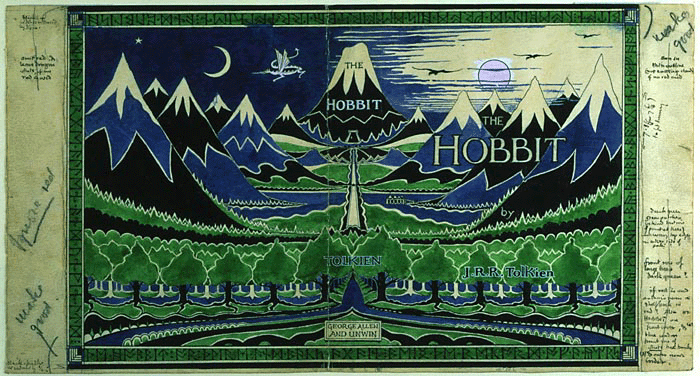
REVIEW: The Hobbit by J.R.R. Tolkien


The Hobbit
by J.R.R. Tolkien

"He was trembling with fear, but his little face was set and grim. Already he was a very different hobbit front he one that had run out without a pocket-handkerchief from Bag-End long ago. He had not had a pocket-handkerchief for ages. He loosened his dagger in its sheath, tightened his belt, and went on."

I was getting frustrated with Joe Abercrombie's The Heroes (which I am sure will appear on this blog in due course), so I put it down to read this old favorite. 

Bilbo Baggins is a comfortable, respectable hobbit, happy to wile away his days in his cozy hobbit hole and live an unremarkable life. Gandalf, however, has other plans and whisks Bilbo away on an adventure through the Misty Mountains and the dark Mirkwood, over the River Running to the Lonely Mountain with a group of surly dwarves, and the little hobbit is changed forever.

I have loved this book ever since my dad read it to me as a child. He would do all the voices and sing all the songs. I don't think I have read it since middle school, though, so it was a bit of a jarring experience to read it again at age 27, after having read and seen the Lord of the Rings and while waiting impatiently for the Hobbit movie to come out. It colored my experience a bit.

It took me a while to get back into the style of it. It is a child's story and thus views Middle Earth through an incredibly innocent lens. Gandalf is the uber-adult, who takes care of the hobbit and the dwarfs, and makes such statements like "I am such a great wizard, and even I was concerned for a moment." You know that if Gandalf is there things will turn out ok. It was hard to reconcile this Gandalf with the Gandalf in LOTR at times. The imminent danger of death is not there, as it was in LOTR. It is very much a "hobbit's holiday," where things get dangerous (or "uncomfortable" as Bilbo says), and there is a potential for death, but not like it was for Boromir, or Haldir, or Theodin or any of the thousands who were slaughtered in LOTR. This is the world Pre-Sauron, where when you went on adventures, it is a great surprise to encounter severe problems (as it was for the dwarves at the start of the journey). Characters do die, but it is not portrayed as a brutal waste, but as a noble and kingly end. 

It was also difficult to reconcile the Hobbit elves (merrymaking, singing and making jokes) with the elves of LOTR (serious, ethereal and rather dull). 

However, the meat of the story still gladdened my heart: the story of a silly gentleman hobbit who is thrust into a quest against his will and transforms into a brave, wise, and resourceful adventurer (though he still occasionally longs for his cozy hobbit hole). The encounter with Gollum was as creepy and clever as ever, though I still don't understand some of the riddles). I started to really get invested once the spiders hit (one of my favorite moments) and Bilbo comes into his own. The moments come fast and furious after that: the Elven King, Barrel-Rider, banter with Smaug, the Arkenstone, the dwarves bursting out of the mountain into battle,  the deaths of friends, the journey home and the auction and the epilogue. 

The language was a delicious blend of the poetry of the Viking Eddas and simple English country talk. Some of the phrases role rhythmically off your tongue, like "The Arkenstone of Thrain," or "Thorin Oakenshield." Sometimes they use high romantic language, and Tolkien translates it into plain English for the reader, which amused me greatly: "'We are sent from Dain son of Nain,' they said when questioned. 'We are hastening to our kinsmen in the Mountain, since we learned that the kingdom of old is renewed. But who are you that sit in the plain as foes before defended walls?' This, of course, in the polite and rather old-fashioned language of such occasions, meant simply: 'You have no business here. We are going on, so make way or we shall fight you.'"

I also enjoyed how he let the dwarves be grumpy. Often in modern culture there is a huge push to hide that you are out of sorts, or to get out of it as soon as possible; that it is a deficiency in yourself if you allow any negativity. Tolkien lets them sit in their grouchiness for a while, and not only is it allowed, it is natural and justified! They would scold the hobbit and sulk for a while if they had been scared for no reason, or if they had no food, or if they had spent a few days bobbing in barrels. And it was understood, allowed, and passed naturally when they had a good meal, or were left alone for a while. 

The Hobbit is always worth a re-read, and makes me very happy in this cold weather to go home to my cozy hobbit hole, eat a good meal, and drink tea in front of a hypothetical roaring fire. 


Thursday, October 13, 2011

ARCHIVED REVIEW: Howl's Moving Castle (8/19/11)


Howl's Moving Castle
by Diana Wynne Jones

"By now it was clear that Howl was in a mood to produce green slime any second. Sophie hurriedly put her sewing away. "I'll make some hot buttered toast," she said. 
"Is that all you can do in the face of tragedy??" Howl asked. "Make toast!"

Sophie is the eldest of three sisters, and everyone knows it is the youngest that gets the adventure and the prince. Just when Sophie resigns herself to a life of mousy mediocrity, a run-in with the Witch of the Waste turns her into an old woman. Freed from the conventions of youth, Sophie sets off on her own, and bullies her way into the moving castle of the wizard Howl, in hopes of a cure.

This book was delightful, funny, and heartwarming. I confess I did have a difficult time separating it from the movie. I saw Sophie and Calcifer as the movie portrayed them, which was fine, but I wish I had been able to see my Howl with fresh eyes.

I enjoyed Sophie's transformation from timid youth to temperamental old woman. She was freed by the realization that as an old woman, she could do and say what she liked, and this attitude launched her into her adventure. She could have lead quite an unremarkable life if she had remained as she was.

I loved how Diana Wynne Jones portrayed the small, weird family that gathers in the moving castle. At first, Howl is quite alone with Calcifer (the snarky fire demon who moves the castle, and cooks the bacon) and ignores Michael (his student). With Sophie's appearance, they create an odd domestic circle, settling into rhythms and coming to rely on each other as more and more strange beings enter their family: a man-dog, a turnip-headed scarecrow, etc

In Howl, she creates a fantastically charismatic, and deeply flawed man: a vain, powerful, cowardly baby who can be kind and vulnerable one minute, and flooding the house with sulky green slime the next. He works subtly on the reader, as he does on Sophie, and soon, even though he is a bastard, you feel deeply for him. Still, Sophie does not take any of his shit, and it makes my heart hum to hear him being ridiculous and have her take him down a peg or two.

She spins Sophie's relationship with Calcifer and Howl so subtly and so well, that the ending comes as a satisfying surprise. You were not expecting it, but when you looked back, you knew that all was as it should be.