Showing posts with label victorian age. Show all posts

Thursday, May 29, 2014

REVIEW: Delilah Dirk and the Turkish Lieutenant by Tony Cliff

17261174

Delilah Dirk and the Turkish Lieutenant
by Tony Cliff

Erdemoglu Selim is resigned to his lot as a low level officer in the Turkish Jannisary corps. Delilah Dirk is a globetrotting troublemaker, adventurer, and treasure seeker who ends up in the Turkish prison. Selim is in charge of interrogating her, and when she escapes, he is accused of being complicit, so he reluctantly accompanies her on her swashbuckling adventures. When he is given the chance, will he embrace the wonderous life she has shown him, or settle down and finally drink that perfect cup of tea.

Holy swashbuckling adventure, Batman! This book was just as rollicking as it promised on the cover. A daring, sassy female fighter with her steady companion face challenge after challenge, from burning airship to angry mob. Their banter and the deepening of their relationship are what cemented my love of this graphic novel.

It was a fast read too! I got it got to read on the metro to and from an event, and I finished it before I even got there. Fast fun kickass heroine adventure candy.

Friday, May 16, 2014

REVIEW: The Firefly Letters by Margarita Engle


The Firefly Letters
by Margarita Engle

We go out at night 
to rescue fireflies.

Children catch the friendly cocuyos
and pull off their wings
or put them in bottles
to make little lamps
where the insects glow and fly
until they starve.

Women tie living cocuyos
onto their ruffled dresses as ornements
and girls weave them into their hair 
like flashing jewels.

Fredrika and I
feel like heroines in a story, 
following people around
buying captive fireflies
and setting them free.

A novel in verse, Engle tells the true story of Fredrika Bremer, a Swedish suffragette, who travels to Cuba to document life there at the turn of the century. She is given an African slave named Cecelia to translate for her. Fredrika's host family has a young girl named Elena who has never been outside her house and is strictly told what is and is not expected of a noble lady. The novel is structured into short poems from the perspective of Fredrika, Cecelia, Elena, and Cecilia's husband Beni, as they reveal the pleasures and darker underbelly of Cuba.

This was a delightful book. I had expected a bit more action, but the lyrical poetry was enchanting and I was taken on a lovely ride. It was fascinating to learn about Cuba at that time and see how the three women help each other to grow. It is an interesting exploration of slavery and captivity in all its forms.

Monday, November 4, 2013

REVIEW: Dodger by Terry Pratchett


Dodger
by Terry Pratchett

“Dodger made haste towards the house of the Mayhews while in his mind he saw the cheerful face and hooked nose of Mister Punch, beating his wife, beating the policeman and throwing the baby away, which made all the children laugh. Why was that funny, he thought? Was that funny at all? He’d lived for seventeen years on the streets, and so he knew that, funny or not, it was real. Not all the time, of course, but often when people had been brought down so low that they could think of nothing better to do than punch: punch the wife, punch the child and then, sooner or later, endeavour to punch the hangman, although that was the punch that never landed and, oh how the children laughed at Mister Punch! But Simplicity wasn't laughing...” 
It was a dark and stormy night in turn-of-the-century London. A girl's scream rips through the air as she tries to escape a carriage with two brutish men on her heels. Suddenly, a young man emerges from a sewer drain and saves her. Thus Dodger, common geezer and tosher (person who explores sewers for lost items), gets swept up in a mystery that involves Charles Dickens, Henry Mayhew, Benjamin Disraeli, and even foreign powers. Will he be able to solve the mystery of the woman in the coach, and will he be able to maintain his identity as his star rises?

Pratchett calls this book a historical fantasy, and I can definitely see how that is true. It is more like historical fan fiction, where he manipulates facts to give you a really fun story. It took me a while to get into the rhythm of his long, convoluted and clever sentences, but I really enjoyed the book.

The world was excellently drawn, almost too much so, for I felt sometimes he was letting the historical personages run wild with their opinions on the world more than letting the plot advance. However, the characters are really fun, if a bit flat. The two characters that stand out in relief from the others are Dodger himself and his mentor and landlord Solomon. Solomon is a practical, cosmopolitan Jewish refugee. He lives simply and speaks wisely, and plays his cards close to the chest. It bothered me that Pratchett seemed to be implying that Fagin from Oliver Twist was based on Solomon, for Solomon was nothing if not an amazing role model. Dickens actually went back and apologized for the anti-Semitic portrayal of Fagin in Oliver Twist, so it colored my view of Dickens in the novel.

Dodger is a surprisingly compassionate hardened geezer (clever, streetwise person). He is more complex than you realize at first, protecting his town, and if he lies and manipulates a good person, he makes sure they are recompensed. He sees all sides of a situation, and feels sympathy for those who are portrayed as "villains" in the eyes of the public. I do sometimes wish that he was actually genuinely scared or that he failed horribly once or twice in the story, because his constant successes made me hate him a little, but just a little.

I honestly was expecting a lot of horrible things to happen in this book which never happened. Perhaps, I forgot this was a Pratchett novel, and not just a regular historical/ literary adaptation where they try to take the story down dark roads.

All in all, a pleasant and fun romp through 17th century London.

Books Like This:
The Wee Free Men by Terry Pratchett
Sacre Bleu by Christopher Moore
Oscar Wilde and a Death of No Importance by Gyles Brandreth


Wednesday, May 8, 2013

REVIEW: Airborn by Kenneth Oppel


Airborn
by Kenneth Oppel 
“Why do you need to fly so much?” she asked.
“If I don’t, it’ll catch up with me.” The words just came out.
“What will?”
I took my hands from my face, panting. I stared out at the storm.
“Unhappiness.” 
Matt Cruse is the cabin boy aboard the airship Aurora and he loves it. When his father died serving on the Aurora, Matt took his place. He feels more at home in the sky than on the ground, and he has earned the reputation of being lighter than air and a smart, capable crew member. When the Aurora rescues a dying old man in a battered hot air balloon who speaks of strange flying creatures, Matt is ensnared in an adventure. Together with the man's granddaughter, Kate, they must sail the skies, battle pirates, and save the ship, all while searching for the elusive creatures her grandfather saw.


This was a fun book! A rollicking high seas adventure, mixing Robert Louis Stevenson with a bit of Jules Verne. It reminded me a bit of the Leviathan trilogy, but lacked the depth of character and scope and detail that made that series so great. While Leviathan was a dirty, gritty, wartime story, the Aurora is a luxury liner. The story is a frivolous peace-time adventure. That is not to say the stakes are not high. Towards the end of the story, after much sneaking off to explore and outwitting authority figures, the danger becomes very real, and Oppel is not afraid to kill a few people to remind you how real it is.

The worldbuilding did feel a little sloppy to me. We had airships lifted by the new element, hyrium, with its own rules, and some exciting cryptozoology, but we don't learn much about the rest of the world. It appears to be simply a steampunk novel with airships and message tubes, with everything else simply Victorian. However, there are subtle name changes that make you wonder what kind of alternate universe we are in: Pacificus and Atlanticus oceans, Angleterre, instead of England.

The characters were a bit surfacey. Kate is the plucky, headstrong Victorian girl who wants to be a scientist and doesn't care if her recklessness causes problems for other people. Matt has the dark undercurrents of pride and jealously that were so successful with Victor in Oppel's His Dark Endeavor  but the flaws did not pay off as significantly in Airborn. He is simply your Everyman with emotional baggage and something to prove. I will say, though, that the captain of the ship, even though he was rather one dimensional, had an excellent management style!

I can picture how amazing this book would be if Oppel delved just a little more. The issues of jealousy between Matt and another crew member. The evil pirate captain and those he loves. Preservation versus public access in regards to a rare species of animal. Trying to rebel and prove yourself even though it endangers those around you. Loyalty to your home versus saving someone you care about. All of these could be mined for so much more emotional gold.

Yet, however superficial the adventures seems at times, everything, even the smallest detail, comes back in a big way, and will either pay off emotionally or  become a linchpin to the plot. It is fascinating to pick up on the clues as you go, or have the "Oh my God! The thing from before!" moment when one has slipped by you.

All in all, a nice, light, fun, easy adventure read for the summer.

Books Like This
Stardust by Neil Gaiman
Leviathan by Scott Westerfield
This Dark Endeavor by Kenneth Oppel

Tuesday, February 12, 2013

Re-Read: Frankenstein by Mary Shelley


Frankenstein
by Mary Shelley

“I expected this reception. All men hate the wretched; how, then, must I be hated, who am miserable beyond all living things! Yet you, my creator, detest and spurn me, thy creature, to whom thou art bound by ties only dissoluble by the annihilation of one of us. You purpose to kill me. How dare you sport thus with life? Do your duty towards me, and I will do mine towards you and the rest of mankind. If you will comply with my conditions, I will leave them and you at peace; but if you refuse, I will glut the maw of death, until it be satiated with the blood of your remaining friends.” 

Walton is a young, passionate explorer on an expedition to the Arctic. He is consumed with his own trials and tribulations and loneliness, until one day, a bedraggled, dying man crawls aboard his ship. Thinking he has finally found a friend, Walton is horrified to hear the haunted story of the man, Victor Frankenstein, and the monster he created.

I remember absolutely loving this story in high school. It was all about how man should not play God or the consequences would be dire. We learned all about the sublime, the concept of something so beautiful and awe-inspiring and terrifying at the same time. It was certainly the best monster book I read (Dracula was too weirdly sexy and Jekyll and Hyde was boring if you knew the twist at the end). Reading it again, however, I was struck by so many new things! 

I can see why high school me was so in love with it. It is the perfect book for a high schooler. Everything is so dramatic! Victor is the center of his own universe. Everything lives to serve him. Everything that happens to him is either the best thing in the world, or the worst thing of all time. Granted he is dealing with a bit more than high school politics, but it is a very high school state of mind. Very melodramatic and full of big, juicy ideas of fate and death. 

During this re-read I was shocked to realize that the book was about something completely different than what everyone told me. It was not about how a scientist tried to play God and was punished for it. Victor succeeded in playing God. It worked. He succeeded beyond his wildest dreams. Even though the creation is a newborn, and is unable to articulate or comprehend on an adult level, he grows quickly in mental and emotional capacity, so that within a year of being born, he can express himself better than I can! He is fully human. He is thought of as sublime, like the mountains or a thunderstorm, all naturally occurring things. The only downside is that he is ugly (rather than the angelic, noble visage Frankenstein intended), and those seeing him for the first time run in fear or hurt him. The resurrection process works. Frankenstein is not punished for trying to create life, for creating an unnatural aberration. He is punished for not taking responsibility for it. 

Victor spends a lot of this book avoiding things. When he first see's the monster, he faints, and then goes and takes a nap. And then is sick for a long time. He never thinks to ask where the monster went, he is just glad he is gone. In fact, he spends a lot of this book unconscious or on vacation in beautiful places, trying not to think about the monster. If I was the monster, I would get frustrated with him too!

It is assumed that the monster is responsible for the deaths of everyone in the book. And that is technically true. He does kill all but one of them. However, in each case, Victor could have prevented the death by taking responsibility for his actions. William's death is the result of Victor not taking responsibility for the care of the monster immediately upon creation. Justine's death is because Victor would not stand up before the court and say "I created a monster, and I saw him in the mountains where William was killed," because he thought people would think he was crazy. So Justine died for the murder of William because Victor did not speak up, even to say "I saw a scary man on the heath." His reputation was more important than Justine's life. 

Victor refused to make a bride for the lonely monster. He makes excuses, saying that the monster is evil, and so she will be evil, and they will have thousands of evil children (can they reproduce?), or they might not even like each other. Much flawed logic there. The monster is lonely and cruel because he has been treated with cruelty his whole life. He is not inherently evil. If anything. he is inherently good, and has learned cruelty from never having been treated with love. He has the most human-like war of love and hate within himself. He has as much of a chance as any other human has to be good and happy, perhaps more so, as he is so much more self-aware than many humans I have met. While I understand that it would suck to be the bride of the monster and wake up to a husband you hated, I say, give the crazy kids a chance? The monster takes full responsibility for the situation, and all Victor has to do is make her, and the monster will stop killing his friends and move to South America. But Victor throws a hissyfit and destroys the bride, and so Clerval dies. And then Frankenstein's own bride, Elizabeth (the epitome of all things good and angelic and flat) dies as well. 

As you can see, the monster has convinced me. While he does some horrible things, I know exactly why. He explains himself clearly, calmly, and logically, appealing to emotions as well as reason. He states, "If you would only accept me, I would be amazing and good and love you and everyone! I would frolic in the fields and pick daisies and put the star on the top of the Christmas tree" (not a direct quote). But Victor flails and blames fate and calls the monster names, and does not address any of the monster's concerns. Honestly, the monster makes a better argument. 

I am not saying that he should have killed everyone. I am saying that Victor needed to grow some balls and stop avoiding his responsibilities as creator. 

I was also rather surprised to realize that Victor creates the monster in an apartment in the city, not in a castle. There is no mention of electricity (aside from the fact that he is inspired by lightning striking a tree); he flatly refuses to tell us any details of how he did it. There is no Igor. The monster is afraid of fire when it burns him, but then he learns to make it, and it is all fine. He is initially inarticulate, but then learns to speak and read. There are no angry villagers, or pitch forks of any kind. No one even knows the monster exists. It is just Frankenstein vs. the monster pursuing each other until death. A tale in two strong voices wrestling with each other for all time.

I would love to see a faithful adaptation of the book, not a faithful adaptation of the original movies that were only based on the book in so much as there was a guy named Frankenstein who made a monster. The ideas of fate and responsibility are so juicy that it doesn't need to be "improved upon" by completely disregarding the stuff already there for new made up stuff. Anyway, that is a rant for my Dark Forest blog when I talk about Frankenstein in Once Upon a Time. 

Sunday, April 15, 2012

REVIEW: Oscar Wilde and a Death of No Importance by Gyles Brandreth


Oscar Wilde and a Death of No Importance: A Mystery
by Gyles Brandreth

"Oscar's conversation was so brilliant he could make you forget the toothache. That night we sat in a dark corner of a London club with a dead man's head in a box before us and for forty minutes thought not a thing about it."

Oscar Wilde arrives at a (potentially illicit) appointment to discover his young friend Billy Wood dead with his throat slashed. With the help of his friend Robert Sherard (Watson to Oscar's Holmes), and his friend Arthur Conan Doyle, Oscar slips around London's drawing rooms and dark alleys to solve the mystery.

This book was a delightful read! The mystery itself was not that compelling, as it dragged on for months. It was predictable enough that I had it narrowed down to two suspects before the big reveal, but not so much that I knew for certain. 

The real fun of this book is Oscar himself. I loved this man before I read the book, but now, seen through the eyes of Brandreth (who was a biographer first), and through the fictional lens of his friend Sherard, I love him even more. He is at once the most commanding, jovial, and kind man you have ever met, and at the same time secretive, vulnerable and moody. He was very frustrating at times, deliberately withholding information from his friends, but you forgave him because he was such a generous and charismatic man. 

One element I found quite compelling were the comparisons between Oscar and Sherlock Holmes. In this book, Oscar is a great observer of human nature, like Holmes, and can tell everything about someone just by looking at him. Oscar also has a brilliant mind that is tainted by his one vice - in Sherlock's case, cocaine; in Oscar's case, young men. Conan Doyle also confesses (in this book) that he based the character of Mycroft Holmes (Sherlock's smarter older brother) off of Oscar, as the man who languidly sits in his club all day, until something sparks his interest, and then he can move a lot faster than you ever thought. (I LOVE that Stephen Fry has now played both Mycroft and Wilde).

I was planning on finding the book chock full of references to Wilde's works, but I could not find that many. He often quoted himself, and I'm sure he did it more often than I caught, but it seemed like he quoted Shakespeare the most. One moment that broke my heart was when he sadly muttered to himself Andrew Aguecheek's lament from Twelfth Night "I was adored once too..." 

All in all, a fun read. It would be even more fun if the whole sodomy trial wasn't looming over everything. As wonderful as Oscar's life is at this point, our foreknowledge of his fate makes everything he does part of his great tragedy. 

Books like this:
The Sherlockian by Graham Moore
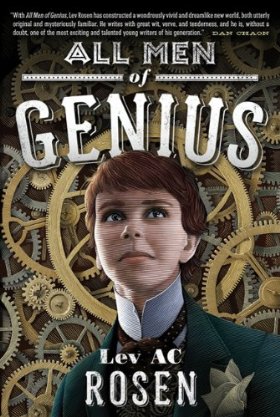
All Men of Genius by Lev AC Rosen

Monday, November 7, 2011

REVIEW: All Men of Genius by Lev AC Rosen


All Men of Genius
by Lev AC Rosen

"Furthermore, I don't recommend emulating the behavior of any of the characters contained within.
They're all quite mad.
The truth is, I have no idea what I'm talking about.
Except about love. We all know a little about that.
Or nothing at all."
- Author's Note

This book is a basically a steampunk mashup of Twelfth Night and The Importance of Being Earnest. Need I say more? Well, I will anyway.

Violet Adams is not your typical Victorian girl. She spends her spare time up to her elbows in grease and gears in her family's basement inventing wonderful things. She is serious and bullheaded, and frustrated that because she is a girl, she will never be recognized for her genius by her scientific peers. Her twin brother, Ashton, is the opposite: an easy-going poet and all around foppish cleverboots. 

She hatches a plan to dress as a boy so she can enter Illyria College, the best scientific school in the city. Along the way she makes friends and enemies (an excellently bitter and entitled Malcom Volio), falls in love, fights against an evil plot, is awesome and smart, and fights an incredible battle to win her place in the scientific community. 

I. LOVED. THIS. BOOK. It is crammed with characters and references to both Twelfth Night and Importance of Being Earnest, but it is not slavishly devoted to either story. You get themes, characters, delightful flavors, and sometimes direct quotes, but Rosen makes them his own. For example, Mariah from Twelfth Night is Miriam Issacs, a "Jewess" born in Persia, married and widowed in Paris, and then employed as governess to Cecily (Cecily/Olivia). Miriam's relationship with student Toby Belch warms my heart. Cecily is as naive and youthful as Cecily Cardew, and falls for Violet-dressed-as-a-boy a la Olivia. Violet herself (after a long struggle) falls for Earnest, Duke of Illyria. Another example: One of the Professors is named Bunburry, and he rather accident prone. 

Like Neverland, it is nicely crammed, and there is hardly any space between one reference, and another, but if you don't know either play, you can appreciate the book for its own merits. And if you do know both plays, you will not be ruined on the story. 

It sounds complicated, but it doesn't feel that way while you are reading it. Reading the book feels like surfing, where you ride the rhythms of each section, and switch to the next wave of text as it comes. It is easy and exciting, and flows really well. And then, like a video game, you collect the little gold coins of allusion as you ride. 

The 3rd person point of view slides just as easily. Each character, including all the minor ones, gets their moment (or more) of perspective. You get to look through the eyes of of the all main characters, of course, but then you have moments when you are in the brain of Lothario Prism, the aging professor, to get his unique perspective on the science faire set up at the Crystal Palace, or Fiona, the burlesque actress Violet hires to be her maid, and who ends up seducing Drew Pale (a still pitiful, but happier Andrew Aguecheek). 

I also loved Violet's character development. At the beginning she was brash and fearless because she was naive and young. As she matures, she hones those features into a genuine bravery and strength of character. She learns that femininity is not weakness, and she that she can be both a girl, and fully herself. 

The book is also chock full of imaginative, steampunky science, which for the most part I loved. However, biology class made me cringe a bit. The biology class's sole purpose is to experiment on animals. Rosen does have Jack Feste upset when he kills an animal in his experiment, but the idea of "improving" animals (giving ferrets bat wings, or switching animal's voice boxes), while it lead to comical outcomes, made me uncomfortable.

Other than that, this book was probably the best book I have read on a long time. It is not a heavy, weighty tome of genius, but it was clever, funny, engaging, exciting, and had wonderfully detailed characterization.

Books like this:
Leviathan, Behemoth and Goliath by Scott Westerfield

Tuesday, October 25, 2011

Unfinished Book: The Affinity Bridge


The Affinity Bridge
by George Mann

Ladies and Gentlemen, I am sorry to say this so early on in my blog, but I could not finish this book. I vowed to give it 100 pages before I gave up, and I did. However, I did learn a lot from reading it, especially about my own taste and style, so I thought I'd devote some time to it on the blog. 

The story takes place in steampunk Victorian London, where Sir Maurice Newberry (a paranormal investigator) and his new assistant Ms. Veronica Hobbes try to solve the mystery of the crashed airship and the glowing murderous bobby, while trying to avoid the zombie plague. This is a recipe for awesomeness, yes?

Alas, it does not fulfill its potential. First, the characters are incredibly flat. Sir Maurice is a good-natured, reserved middle-aged English gentlemen. He accepts a woman as his assistant and treats her as a (delicate and feminine) partner. He is extremely attentive to her. He has a problem with laudanum, which is probably his most interesting attribute. But there is absolutely no color or texture in his character, no unique voice.

Ms. Hobbes was even more disappointing. When I see boy/girl detective partners, I expect playful snarky banter. Maybe I've been spoiled on too many episodes of Castle, Warehouse 13...or really any other boy/ girl detective paring. I wanted it to be Emma Peel and John Steed. I got bland, restrained, grey, blah. For example, I have no idea why she was hired. Sir Maurice has complete confidence in her abilities, though all we saw her do in the first 100 pages was clean well, make tea, state the obvious (at which everyone gasps and sputters to hear such wisdom from a girl), and vomit at the sight of bodies. I would have loved to see some glimpse at the extraordinary, a reason why a woman would get that position, a reason why Sir. Maurice treats her like trusted friend only after a few days. They are quite touchy-feely too, and makes you think there are romantic flutterings, when that does not seem to be what the author intends. 

The style bothered me the most. It may be because I recognized a lot of my own flaws in his writing, but it got to the point where I got so annoyed by the frequent blunders, couldn't read any more. It was like being beaten to death with a swarm of cotton balls. 

1) Repetition: First, he repeats metaphors mere pages apart. For example, he describes a crashed airship as a beached, dead, half-rotted whale, and then a page away describes it as a dead ancient primordial beast (with the skin rotted in places, and the ribs exposed, etc). Second, he repeats information. For example, he mentions in a telegram to Newberry and Hobbes that 50 people were killed in the airship crash. When they are told the same information at the crash site, Ms. Hobbes gasps in surprise and horror. Third, he has a bad habit of describing the same action from two different POVs without adding anything new to it: He describes Ms. Hobbes pulling her cloak to her because she is thinking of the dead bodies from the airship, and a few lines later, he has Sir Maurice observe her pulling her cloak to her because he presumes she is thinking about the dead bodies from the airship. We know.

2) Word choice: "pucker up that resolve." Really? Not pluck? Pucker just sounds dirty. He also loves the phrase "reminiscent of..." when presenting a metaphor. And his metaphors often are not well-chosen either. He describes "an army" of men, which he clarifies a sentence later as "at least ten." Most of the time he sounds like a man with a limited vocabulary using a thesaurus. 

3) Violent Emotional Reactions: I believe this is not a character trait, but a style snaffoo. When Sir Maurice is introduced to a character, we get a description of that character, and a sudden declaration from Sir Maurice that he admires or loaths the character, without making it clear what was to admire or loathe.   He also has violent reactions to any opposition. When police or a clerk won't give him information -- they don't know who he is -- he gets very shocked and huffy, and waves his Crown credentials around, and then the peons go scurrying. It does not match with his fatherly academic demeanor, and makes the reader think he is a dick. 

4) Don't Tell Me, Show Me: My favorite writers are able to give you character by describing how a character picks up a pen. Alas, this book is Tell City. For example, there is a passage where the author illustrates Sir Maurice in his study. Mann tells about about the character's relationship with the room using cliches, his "haven" and "the one place he could relax, and feel free to become himself" (though I saw no difference between himself inside or outside the study). I would rather have seen his relationship with the study through the way Sir. Maurice interacted with it (entered it, threw things, flopped, argued with his housekeeper about keeping out, etc). Telling runs rampant throughout the book. 

5) "These do indeed 'seem' for they are actions that a man might play": Mann has a tricky POV. Sometimes he is in Sir Maurice's head, and other times he is in Veronica's head (not that it really makes any difference). However, sometimes he is in 3rd person omniscient, and still his characters "seem" or "look like" they are doing things. Why the hell can't they just do them? Whose eyes are we looking through that we are guessing? I do this all the time in my own writing, so I don't have to fully commit. COMMIT! It makes the writing stronger. Don't say "seem" unless there is some doubt about the action.  

I think George Mann desperately needed a good editor. 

Please take my review with a grain of salt, as I have not finished the book (and I feel it an extreme defect in  a mystery novel if I don't care what happens). Please, if anyone has finished the book, and feel that I have misrepresented something, let me know!

Thursday, October 13, 2011

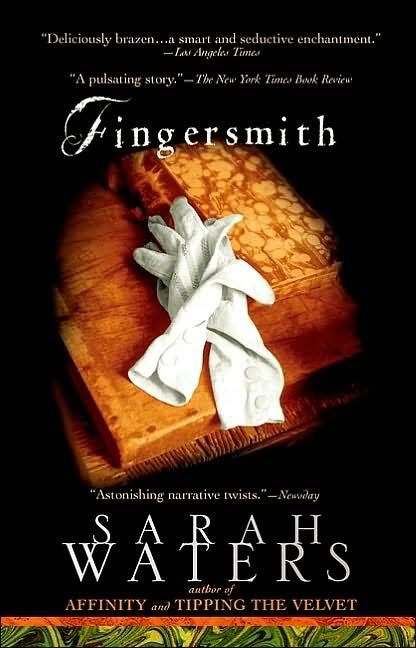
ARCHIVED REVIEW: Fingersmith (8/3/11)


Fingersmith
by Sarah Waters

"All day I sat or walked with her, so full of the fate I was bringing her to I could hardly touch her or meet her gaze; and all night I lay with my back turned to her, the blanket over my ears to keep out her sighs. But in the hours in between, when she went to her uncle, I felt her—I felt her, through the walls of the house, like some blind crooks are said to be able to feel gold. It was as if there had come between us, without my knowing, a kind of thread. It pulled me to her, wherever she was."

Susan, a girl raised among thieves in dirty Dickensian London, is sent disguised as a lady's maid to a cavernous, decaying mansion to woo an innocent, fragile, dowry-full maiden for a rogue known as the Gentleman and help him steal her fortune. She thinks the money is worth it, but all is not as it seems.

This book was excellent! The structure was a strange, measured waltz for two women: the story begins from Susan's point of view, and then, with a dramatic and always unexpected plot twist, the narrative jumps to the other girl. Each time, the same series of events is retold, and everything you assumed was truth is turned on its head. You are constantly on the edge of your seat, wondering what sudden twist the story will take next and how it will all end.

Waters has an incredible eye for detail, and understands how one gesture or sigh can be grossly misinterpreted depending on who you are and where you are standing.

The two tales braid together in a story of treachery, madness, murder, duality, and desire.

And yes, there is lesbian love. It is a lesbian Victorian Dickensian lovefest. Though not as much as I had expected, mostly unrequited passion. What sex scenes there are are beautifully emotional and sensual, rather than sordid, voyeuristic or graphic.

Very well-written, and not a word was wasted. I definitely recommend it to anyone who loves the Victorian Era's underbelly like I do.

If you liked this book, you may like:
The Devil in the White City by Erik Larson

Wednesday, October 12, 2011

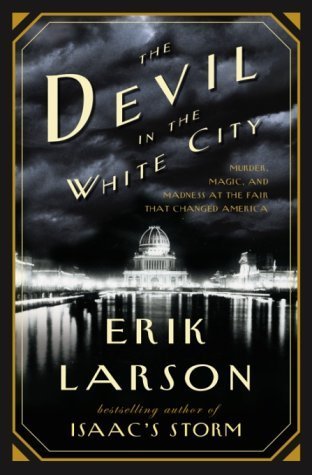
ARCHIVED REVIEW: The Devil in the White City (10/6/10)


The Devil and the White City
by Erik Larson

The book is non-fiction and tells of the vision, brilliance and underdog tenacity that it took to bring about the Chicago World's Fair, and the serial killer who haunted its streets.

I did not think I would like this book but I loved it! It did exactly what I think history books should do: plunk you down in the middle of the noisy smoky street in Chicago in the late 1890s, next to David Burnham (the main architect for the World's Fair) as he asks you the time. In other words, history books should be a TARDIS. 

It gives you all the sights, smells, and textures of the world and the sighs, tears, chuckles and fury of its players. The reader becomes as familiar with them as with their hometown and its denizens. Sometimes this goes a little far, often putting the reader alone in a room with the serial killer as he revels in his kill, which teeters on the realm of historical fiction, but the author acknowledges those moments in the back of the book, and cites the sources by which he reconstructed the scene.

The book is an tantalizing juxtaposition of the hope and struggle of Burnham and the Chicago people to create the forefather of Disneyland, and the cold and seductive machinations of H.H. Holmes, the man who used the fair as bait.

I recommend it even if you don't like non-fiction. It is, in fact, a non-fiction gateway drug.

If you liked this, you may like:
Fingersmith by Sarah Waters
Steampunk Fiction