Showing posts with label ya. Show all posts

Thursday, May 29, 2014

REVIEW: French Milk by Lucy Knisley

1574310

French Milk
by Lucy Knisley

Lucy Knisley (author of Relish) takes a trip with her mother to Paris as a present for her 22nd birthday. Knisley keeps a graphic journal of their days there, filled with museums, food and shopping.

I really wanted to like this book more than I did. I thought that since it was a single story, rather than Relish which was a reflection on her entire childhood, that it would have more of an arc. However, as it reflected real life, it was simply a record of days. The trip was enviable (and seemingly well-funded), and as a result, I wanted to go back to Paris and visit some of the places she went, but I didn't really enjoy her listing the places she went and the things she ate and the items she bought. She did occasionally have depressive episodes, but they were merely commented on and not explored. Knisley wrote just enough about them to make me start to worry existentially about my own future, as she was doing.

It really made me want to go and have those experiences in Paris for myself, but I didn't really care about reading that she had them. I did enjoy her drawings, however, as they expanded upon the action of the text beautifully. Its just sad that I am not interested in her stories. Perhaps soon she will delve into the realm of fiction and her stories and excellent illustrations will be enhanced with character arcs and conflict.

If you are looking for a fast, light, tour of places to go and things to do in Paris, this is a good book for you.

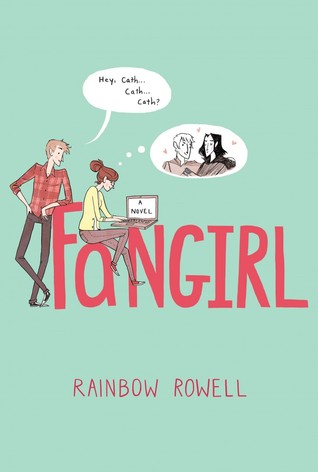
REVIEW: Fangirl by Rainbow Rowell

Fangirl

Fangirl
by Rainbow Rowell

“I'm the Cool One," she told herself. "Somebody give me some tequila because I'll totally drink it. And there's no way you're going to find me later having a panic attack in your parents' bathroom. Who wants to French-kiss?” 

Cath is a Simon Snow fan. A big one. In fact, she writes one of the most popular Simon Snow fanfictions in the world.  Cath is entering college, and for the first time is not rooming with her twin, who she needed to define herself as an individual. With all these new changes in her life, her anxiety is spiking, and it is easy to hide in Simon Snow (a thinly veiled Harry Potter). Yet, little by little, new relationships tempt her to stick her foot out the door into the uncertain world. When her fears about the world are proven to be correct, will she retreat into the world of Simon Snow forever, or gather the courage to face unpredictable real life head on.

I loved this book. I believe Eleanor and Park was probably better, but Fangirl was very personal. It is an excellent exploration of anxiety, the paralyzing fear of the unknown, the fear of waves of "crazy." It was heartening to see Cath open up to new experiences and new friends, even as she held fast to her fandom, first as her shield, and then as a comfort. Her relationship with her kind and driven father who struggles with manic depression, and her relationship with her twin, a fellow Simon Snow fan who begins to have a rather destructive college experience were highly compelling. Her love interests were tender, sensual and silly, but felt a bit one dimensional to me. Perhaps a bit too perfect. But comfy and lovely and highly enjoyable. Rowell has an amazing talent for letting her characters live without forced conflict, and it is still interesting. You watch them be happy, and you are happy for them. That is not to say there is no conflict. Cath must go through a lot to get her happiness.

I highly recommend it to anyone who has been far away from home in a new place, trying to redefine yourself, to passionate fans of anything, and to anxiety sufferers.

Friday, May 16, 2014

REVIEW: Going Bovine by Libba Bray


Going Bovine 
by Libba Bray

“These are hard times. The world hurts. We live in fear and forget to walk with hope. But hope has not forgotten you. So ask it to dinner. It's probably hungry and would appreciate the invitation.” 

All 16-year-old Cameron wants to do is detach and snark and perhaps get with his sister's hot friend. When he comes down with Mad Cow disease, however, everything is off the table. There is no cure. That is, until Cameron sees a beautiful punk rock angel in his hospital room who tells him he must go on a quest to find Doctor X, rescue him from the forces of darkness threatening to destroy the universe, and get his cure. With nothing to loose, he sets off on a roadtrip across America with a hypochondriac dwarf and a lawn gnome who claims he is the god Baldur from Norse mythology.

The thing that hooked me before I even picked up the book was that this was a retelling of Don Quixote. I regret to say, I have never read the original, but there were definite iconic moments I grasped, like tilting with windmill giants, the sidekick, the black knight, and the family who keep trying to bring him back to their reality.

The beginning is brilliant. Cameron describes the best day in his life, the day he went to Disney World, until he rode on the It's a Small World ride, had a weird feeling that they had all died and this was the afterlife, and nearly drowned trying to find what was behind one of the access doors in the ride, sure it was something mystical. Fast forward to 16 years later when Cameron is pretty unlikable. He doesn't try, because why should he? But that all changes when he accepts the quest. He discovers there are things worth fighting for.

This book has some pretty incredible moments. Bray captures images with such weighted specificity. Every piece of the landscape informs the emotional state of Cameron. She is brilliant at creating these moments where reality completely bends and a veil is torn to see what metaphysical things are going on beneath every day life. And yet you are never quite sure if Cameron is really there. Is he traveling across the US, or still hallucinating in his hospital bed? Did he see those fire giants with swinging arms, or was it the disease? She creates these scenes that instill mind-bending terror and awe at the inexplicably and dispassion of such occurrences. In the end, it doesn't matter if it all happened in his head or not. His emotional journey from apathy to deep and painful caring is the same. Bray doesn't pull punches and lets the story play out to it's often heartbreaking conclusions. It is a beautiful and HI-larious story about connecting, and living life and having adventures while you can.

She also gives some great commentary on media and modern public schools which made me laugh.

I highly recommend this book.

Books like this
Odd Thomas by Dean Koontz

REVIEW: Boxers and Saints


Boxers and Saints
by Gene Luen Yang

“What is China but a people and their stories?” 

Boxers and Saints are two companion graphic novels that tell the two sides of the Boxer Rebellion in China in 1898. Boxers follows Little Bao, a boy whose village is bullied and oppressed by Christian foreigners. Vowing to put a stop to it, he and his followers become imbued with the power of the ancient gods and fight the "foreign devils" and "secondary devils" -- the Chinese who converted to Christianity. Spurred on by the spirit of the Emperor who united China, his actions become more and more ruthless until he can no longer tell if his crusade is just. Saints tells the story of Four-Girl who is neglected and abused by her family and finds a home in the local Catholic Church. Baptized as Vibiana, she struggles with her purpose in life. Seeing visions of Joan of Arc, she wants to be a female warrior and lead her people to freedom, but the Boxer Rebellion is coming nearer and nearer, bringing death and destruction in its wake. When the time comes, what will her role be?

It has been a few months since I read these books, so please bear with me. These stories are beautifully told, but brutal and dark. Yang pulls no punches here. He does not flinch from letting his protagonists make very wrong choices. The images are beautiful and striking as each character is lead by visions of their own spiritual guide. I love watching how their two stories intersect and impact each other through life, both at odds, both with good intentions. 

The ending to Boxers leaves you with a kick to the stomach, as does Saints, but there is a kernel of hope at the very very end that makes you feel that people are not entirely terrible. 

Thursday, April 3, 2014

REVIEW: The Last Dragonslayer by Jasper Fforde

The Last Dragonslayer
by Jasper Fforde

“Quarkbeasts, for all their fearsome looks, are obedient to a fault. They are nine-tenths velociraptor and kitchen blender and one-tenth Labrador. It was the Labrador tenth that I valued most.” 

Please forgive me if this review makes no sense. I have Thursday mush brain.

One of my favorite authors, Jasper Fforde, who brought us the Thursday Next series, tells us the tale of Jennifer Strange, a foundling who works for Kazam Mystical Arts Management, a company that contracts out wizards to do home repairs. Magic was once a powerful force in the world, and it is waning. Those who once could turn lead into gold now can barely manage to unclog a drain without help. When a prophecy declares that the last dragon will die on Sunday at noon, the magical community wonders if that means magic will be gone for good. Greedy land grabbers to wait with baited breath along the dragon land border with flags and twine, companies vie for merchandising contracts, and the two countries on either side of the territory are preparing for war. It is up to Jennifer and her pet, the terrifying Quarkbeast, to get to the bottom of this situation while trying to keep Kazam from falling apart.

This was an absolutely charming book. It felt like Harry Potter with all the serious parts taken out and all the goofy random fun stuff kept in.  For a while I thought it was just fluff, especially with Jennifer blithely and confidently sailing through the administrative troubles of Kazam, but the second she doesn't have a witty comeback, you know shit has hit the fan. Those are the juiciest moments, when she is vulnerable and out of her element and must regroup to succeed. I also cheered that Jennifer was a non-magical ADMINISTRATOR! She made sure people filled out the correct form for x or y spell and took care of the more artistically-minded magic workers.

The world is a charming mix of the medieval (wizards, dragons, castles, kings) and the modern (Jennifer's orange VW Bug, plumbing, paperwork, merchandising). Fforde is king of the mash up, and spices it with wonderful jokes like this: “It was written in the ancient RUNIX spell-language, and is read-only and can't be modified.” And a moose illusion that will not go away. And a Dragonslayer headquarters which is a bit like Ghostbusters.

I highly recommend this book if you love whimsy and kick ass female characters.

Other Jasper Fforde Books I Have Reviewed
Thursday Next: First Among Sequels 
The Fourth Bear
Shades of Grey

Friday, March 21, 2014

REVIEW: Cress by Marissa Meyer


Cress
by Marissa Meyer

“I am an explorer,' she whispered, 'setting courageously off into the wild unknown.' It was not a daydream she'd ever had before, but she felt the familiar comfort of her imagination wrapping around her. She was an archeologist, a scientist, a treasure hunter. She was a master of land and sea. 'My life is an adventure.' she said, growing confident as she opened her eyes again. 'I will not be shackled to this satellite anymore.'

Thorne tilted his head to one side. He waited for three heartbeats before sliding one hand down into hers. 'I have no idea what you're talking about,' he said. 'But we'll go with it.” 

Beginning where Scarlet left off, Cinder, Thorne, Scarlet and Wolf are on their ship (voiced by Iko, their droid compatriot) trying to think of a plan to overthrow the Lunar Queen, stop her from marrying Prince Kai and taking over the world. It is not a B movie, I swear. On a satellite circling earth, we find Cress, a long-haired Lunar shell (non-magical Lunar), who has spent her life working for the Queen, hacking their security feeds, monitoring their transmissions, and hiding Lunar movements. In all that time of solitude, she has fallen in love with earth, and more specifically with the dashing and suave Captain Thorne whom she knows is hiding a heart of gold under his selfish exterior. She teams up with our heroes, but when Thorne attempts to rescue her from her lonely outpost, Cress' guardian, the Lunar Thaumaturge finds them, and sends the satellite hurling to earth. In the process, Thorne is blinded (the witch throws the prince from the tower, he lands in thorns and his eyes are gouged out). Cress, newly shorn, and a blind Thorne must find their way across the desert, join Cinder and stop the royal wedding. 

Oh my god, these books are like fairy tale catnip for me. They are perfectly crafted adaptations. They touch on every single iconic moment of the original tales, but it is woven seamlessly into a new compelling science fiction political drama/ adventure novel. In every book, the heroines become more and more pleasing. Cinder was a determined kick-ass heroine along the model that we have seen before. Scarlet was a kick-ass heroine with beautiful weaknesses and flaws. Cress is a quirky shut-in damsel-in-distress, but in a way that does not diminish her complexity or humanness. She does not have awesome fighting powers, but is an intelligent and valuable contributer to the team. Meyer writes strong female characters who do not have to be physically strong, and I adore that. 

The women are not the only ones who develop in this book. Captain Thorne, swashbuckling wannabe extraordinaire who was introduced in Scarlet, must show his quality when he and Cress face the relentless desert, and underneath his swagger he has grit, determination, and genuine tenderness.He is not just prancing comic relief, but a man who deserves the love Cress feels for him. 

Dr. Erland also finds himself on a journey of self triggered by the revelation of his fatherhood, as he attempts to reconcile highly immoral medical practices and his conscience. In my head, I cast Saul Rubinek as Dr. Erland and I think it is perfect. Make the movie now, please. 

We also meet an assholic Lunar guard who might turn into the prince of the next book, Winter. I am super excited!

One last thing I appreciate (of the many things I appreciate in these books) is how Meyer writes romance. There (so far) has been no sex in these books, but the tantalizingly sensual way the characters fall in love is so erotic that there doesn't need to be. How one character touches another softly, or even imagines being touched, is so tinglingly delicious. And yes, romance is a thing, but the focus is saving the kingdom, which shows that their priorities are in order. 

READ THESE BOOKS. That is all. 

The Lunar Chronicles

REVIEW: The Absolutely True Diary of a Part-Time Indian by Sherman Alexie


The Absolutely True Diary of a Part-Time Indian
by Sherman Alexie

“I used to think the world was broken down by tribes,' I said. 'By Black and White. By Indian and White. But I know this isn't true. The world is only broken into two tribes: the people who are assholes and the people who are not.” 

Junior lives on the Spokane Indian Reservation, stuck in a life that has no forward momentum. You are born here, you live here, and you die here, poor as dirt and often mired in a despair that his family and community try to escape in dangerous and addictive ways. After becoming enraged that the textbook he was handed in class was the same one his mother used as a child, he is entreated by his teacher (the target of Junior's book-flinging anger who is saturated with regret) to get out. Junior takes his destiny into his own hands and enrolls in elite school miles away from the reservation, often hitchhiking back and forth. Despite his disadvantages, he begins to thrive, but at what cost? His reservation sees him as a traitor. How can he reconcile his heritage with his dreams?

The Absolutely True Diary of a Part-Time Indian is witty, hopeful and heartbreaking. Junior's voice is so authentic, a teenage boy with an awareness of his community through the lens of his own wants and desires. Often times he is selfish and shallow, but that's being human for you. He begins as one thing, a weakling with an oddly shaped body due to a birth defect to a significant presence at his new school. He is allowed to blossom, rather then stunting and rotting in a place with no space to grow. The tragedy is that those he has left behind remain in this cycle of despair that has lasted generations. Is it betraying his heritage to abandon his community? Is it self preservation? Junior wrestles with these questions as the story continues, through tragedy, pain and bittersweet victory. 

Wednesday, January 22, 2014

Monument 14 by Emmy Laybourne


Monument 14
by Emmy Laybourne

“Your mother hollers that you're going to miss the bus. She can see it coming down the street. You don't stop and hug her and tell her you love her. You don't thank her for being a good, kind, patient mother. Of course not- you launch yourself down the stairs and make a run for the corner.
Only, if it's the last you'll ever see your mother, you sort of start to wish you'd stopped and did those things. Maybe even missed the bus.
But the bus was barreling down our street so I ran.” 

Dean is on his way to school, sometime in the near future, when the apocalypse hits. A massive volcano sets of a chain of events (hail storms, earthquakes, tidal waves) that lead to the bus crashing right outside a Greenway (basically a Walmart). Kids die and the survivors take shelter in the store. The earthquakes lead to chemical weapons escaping from NORAD, and soon no one can go outside without risk of contamination and violent reactions. Dean and the kids (ranging from kindergarten to high school) must work together to survive in the midst of of the most devastating disaster in the nation's history.

As you know, I love survival books. This is probably one of my favorites. It has a milder Lord of the Flies feel, with hormones raging, but not to the extent of the classic. Alliances are forged and broken, love is found and lost. Yet, we never really get too close to any of the characters. They are all still mysteries in Dean's eyes. You get the feeling that you can never really know a person, even if you are locked in a Walmart with them during the apocalypse. The kids are smart, blocking ventilation, creating zones, using resources wisely, creating a home and a routine for the younger kids, finding ways to communicate with the outside world. You wonder how long this community can last and if their destruction will be internal or external. The ending is surprisingly the end of a section, but hardly the end of their story. I am not at all surprised to find out that there are several more books in this world after the end of the story, and I can't wait to read them!

Friday, October 18, 2013

REVIEW: Tiger Lily by Jodi Lynn Anderson


Tiger Lily
by Jodi Lynn Anderson
“I'm not myself," she offered, guiltily. She softened around Tik Tok, and when she did she was, for those rare moments, girlish.
He smiled. "You can never say that. You're just a piece of yourself right now that you don't like.” 
Tiger Lily lives in Neverland, an island in the Atlantic where ships of Englanders occasionally wash up with pirates or children or folks who don't last very long. Englanders have a disease that makes them continue to grow older until they die, something the natives are not subject to. Tiger Lily is an orphan, adopted by the shaman of the tribe, a man named Tik Tok, who is "of two genders": he is a man who wears women's clothing. Tiger Lily lives up to her name: fierce, stoic, and unreadable except by those who know her well. She is a misfit in the tribe, so when she meets Peter Pan, the ominous and deadly boy in the woods, she is caught up in a world where she is needed, special, admired. Her relationship with Peter ignites with heart-thrumming intimacy.  But when Tiger Lily neglects her tribe to tragic results, and when a Wendy bird arrives, will they be able to maintain their connection, or will Tiger Lily lose everything?

This was such a fascinating book. It is narrated by Tinkerbell (not her real name, simply a name Peter condescendingly bestowed). She cannot speak, but she can sense the thoughts and feelings of those around her, making her a unique, slightly omnipotent storyteller. Neverland itself is a strange entity. It is set in our world. Their are fairies and mermaids, but no flying, no "second star to the right." And yet, Anderson manages to maintain what I loved most about the original story: the very real psychology of the characters.

This story also maintains the ache of the original. As an adult reader, you know what things mean. The larger implications of certain feelings become clear. You pity, envy, and are frightened of Peter. He becomes that boy. The one who cannot understand the feelings he is having. The one who shuts himself to any other reality but his own. The one who desperately means to keep promises, but then does not. The one who sends you to the highest highs but also deeply frightens you with what he is capable of. I understood Peter more in this book than in any other interpretation. Hook's desperation for Peter is not the comical Disney or musical version: it is dark and dangerous and self-destructive. Smee is still "lovable" but you remember why he is a pirate and not an affable accountant. He is still a murderer. Wendy is much stronger and also much weaker than in the original. She is so sure of herself because the world cannot be other than how she sees it. The lost boys are not romanticized as off on a camping trip. These boys act the way any children would if they were left to their own devices, forced to survive on their own. They hero-worship Peter, desperate to have some sort of direction, a compass to focus their days. But this, of course, takes a toll on a leader who is still very much a boy himself.

Tiger Lily is wonderfully complex and refreshing. She is not a preteen seductress, nor a silent generic "indian." She is guarded and pained and untrusting but also worthy and strong, and has the capacity for deep love. And she does not, as this book seemed to imply at the beginning, loose her mind, heart and need for life when she loses Peter (as all girls lose Peter).

The cast of new characters are more of a mystery to us, but they are no less compelling: Pine Sap, Tiger Lily's mishapen and introspective friend, and Tik Tok the shaman whose slow tragedy breaks our hearts.

This is a quality Peter Pan adaptation. Well-written and faithful to the spirit of the original.

Monday, September 16, 2013

REVIEW: Stung by Bethany Wiggins


"As I jump out the window, I glance over my shoulder. The window frames a face with smooth skin and hollow cheeks -- a boy on the brink of manhood. He peels his lips back and growls, and I stare into his brown eyes. For a moment it is like looking into a mirror and I almost say his name. Until I realize his eyes are wild and feral, like an animal's...As I sprint across the empty schoolyard, past the silent, rusted playground, I dare a look over my shoulder. My brother is hobbling toward the fence, his angle hanging at an odd angle to his leg. His eyes meet mine and he holds a hand up to me, a plea to come back. A sob tears at my chest, but I look away and keep running."

Fiona wakes up in her bedroom. Everything is covered in dust. The world around her is lifeless, and there is a tattoo on her right hand. She is 4 years older than she was when she fell asleep. She steps into a world divided, where those bearing the tattoo must live outside the wall because they are infected with a deadly disease that could turn them at any moment into mindless beastly killing machines. Those within the wall are safe, but at what cost? When Fiona is captured by the militia, she is marked as a Level Ten, the deadliest of all the infected. Yet, she feels normal. As flashes of memories come back to her, she and her former classmate Bowen, now a hardened militia man, must discover her secret before it is too late.

This book was chilling. The opening images of a normal world gone wrong were nightmarish. Everything left as if the family had just stepped out, but dust-covered, broken, and warped. Vestiges of her old life present themselves in horribly twisted ways.

There are very few elements of the Sleeping Beauty tale in this adaptation, but they appear in the prick of a needle, the many-years sleep, and the healing power of a kiss, just not in the ways you would expect.

The story itself did not grab my heart the way Scarlet did. The bleak dystopia grabbed my brain, however, and I was moved by the dogged perseverance of Fiona towards the end of the book (after a few chapters of some wandering, and following). While her relationship with Bowen is compelling, I was more taken by her relationship with her twin brother Jonah, a Level 10 who has already turned into an aggressive killer, and how his repeat appearances change as the plot advances.

I found that the story meandered a little and the deus ex machina at the end was a little too abrupt and easy, but it was still a satisfying tale, and a fascinating world to explore. A solid sci-fi version of the fairy tale.

And the cover art is amazing, right?

REVIEW: Scarlet by Marissa Meyer


Scarlet
by Marissa Meyer
“A sickening howl stopped her, sucking the air out of her lungs. 
The night's chatter silenced, even the loitering city rats pausing to listen.
Scarlet had heard wild wolves before, prowling the countryside in search of easy prey on the farms.
But never had a wolf's howl send a chill down her spine like that.” 
This second book in the Lunar Chronicles follows a delivery girl named Scarlet whose grandmother has been missing for two weeks. The police have given up, but she tenaciously searches for clues. When she meets a young, handsome, ambiguously affiliated street fighter, Wolf, who might hold the key to her grandmother's disappearance, they embark on a journey that might save her grandmother, or doom Scarlet to the same fate. In the mean time, Cinder (protagonist of the last book), is breaking out of prison with the charming, but rather self absorbed Captain Thorne. And poor Prince Kai is left to deal with the evil Lunar Queen alone. 

I believe I loved this book even more than Cinder! Marissa Meyer creates awesome heroines, all of whom have very strong objectives having nothing to do with love. Any love that they may come across is secondary to their main drives. And so far they have each held jobs traditionally given to men (that of mechanic and delivery person) with unconscious aplomb.

The gentlemen, Thorne and Kai, are given equally complex treatment. Even though Thorne is shallow, you can tell he is capable of more than he gives himself credit for. And Wolf. Oh Wolf. I am a sucker for the primal but sweet and funny but also not-certain-if-he-is-going-to-eat-you wolfman (see Wolf in 10th Kingdom). And may I say, without giving too much away, that damn the romance in this one is passionate.

This book is action-packed with highly creative fights, chases, interrogation scenes, and brawls. The science fiction is deftly woven into the plot so that it is never to exposition or world-building heavy; it just flows with the story. I also appreciated how both the Scarlet story line and the Cinder story line were both equally as strong.

The Lunar Chronicles, Cinder and Scarlet, are probably some of my favorite fairy tale adaptations out there. They give nods to the important elements of the fairy tale: the pumpkin, the shoe, the searching prince, the red cloak, the wolf, the grandmother. Yet they are not slaves to them. They creatively interpret them to create new and compelling stories. As these ladies join forces, I am excited to see who fills out their crew of powerful fairy tale heroes and heroines. The next book, Cress, comes out soon!

Books Like This:
Cinder by Marissa Meyer
Leviathan by Scott Westerfeld
Terrier by Tamora Pierce
The Fourth Bear by Jasper Fforde

Tuesday, August 6, 2013

REVIEW: Marcelo in the Real World by Francisco X. Stork


Marcelo in the Real World
by Francisco X. Stork

“I deal with people like him a hundred times a day. They look at me and naturally assume I'm not as smart as they are. God help us. But think about it, it's a tremendous tactical advantage, not to mention personally liberating, to have others think I'm a dummy.” 

Marcelo is somewhere on the autism spectrum, close to Aspergers, but his doctors have been unable to clearly diagnose him. His special interests are religion and his internal music which sings in the back of his mind and no one else can hear. He is looking forward to spending the summer caring for the ponies at Paterson, the school for developmentally challenged kids he has been attending his whole life. However, his father thinks that he needs time in "the real world" and tells him he has to take a summer job at his father's law firm. Confronted with the real world, Marcelo must squelch his natural interests (talking about religion makes people uncomfortable) and learn the complex rules of the office. He meets Jasmine, his boss, and Wendell, the privileged son of another lawyer, and they help him to see, for better or for worse, what the real world is like. One day, Marcelo sees the photograph of a girl whose face has been sliced in half by a faulty windshield, and he must wrestle with what the real world thinks is correct, and what his heart tells him to do.

Marcelo was a beautiful book! I loved his unique voice right from the start: his need for clarification, his precise imagery (the phone ring sounding like it was full of rage). It was so unfamiliar and yet familiar at the same time. I too have a need for schedules and routine, and sometimes feel overstimulated or unwilling to venture into unknown places.

I was expecting the journey of an autistic boy learning to relate socially to people. I did not expect the deep spiritual elements in this book. And I did not expect the journey of a person from weakness to strength. I didn't expect Marcelo to become a hero with more clarity and self-awareness than most people I know.
I was profoundly impacted by his relationship with Rabbi Herschel and the moments they wrestled with the will of God: the tree of good and evil, and the final scene when they discuss how to listen to what is right, the fact that the right thing might hurt people, but we must trust that God will use the hurt in a positive way. They both touched me deeply.

I was not expecting Wendell the predator. He was such a danger, lurking there in the back of every moment Marcelo’s father was such an intriguing and multidimensional character. I don't want to give too much away, but somewhere he takes a wrong turn and has a difficult time getting back on track. That story is not quite resolved to my satisfaction, but real life never is.

This book is an amazing peak into someone's head that on the street might appear very different to you, but Marcelo struggles with the same things everyone does. He just comes at it from a different perspective. I was sad that towards the end, he begins to loose some of his uniqueness in favor of fitting in, but he develops a gentleness and a strength and a clarity of purpose that I envy. This book is great for those who are searching, for those who do not always fit in, and for those who struggle with what is right and wrong.

Books Like This
The Curious Incident of the Dog in the Night Time by Mark Haddon
Okay For Now by Gary D. Schmidt

Monday, August 5, 2013

REVIEW: The Knife of Never Letting Go by Patrick Ness


The Knife of Never Letting Go
by Patrick Ness

“Noise ain't Truth, Noise is what men want to be true, and there's a difference twixt those two things so big that it could ruddy well kill you if you don't watch out.” 

Todd lives in a strange town. Firstly, they are colonists on a lonely planet: religious colonists like the Pilgrims. Second, there are only men. All the women died when a terrible virus swept through the town, killing all the women and allowing all the men to hear each other's thoughts. It follows the men around like a cloud and they call it The Noise. There are no secrets in Prentisstown. Also, all the animals can talk, which is advantageous in some cases, but when you have an annoying dog who always has to poo, it appears more as an irritating situation.

One day, when Todd and Manchee (his dog) travel to the swamp to gather fruit for his adopted fathers, Todd is startled by a patch of quiet moving through ancient huts. When he returns home, his fathers force him to flee as the sheriff and his posse try to break down the door. Armed only with a book from his dead mother that he cannot read, a knife, his dog and baffled confusion and anger at his situation, Todd stumbles into the wilderness and meets the last thing he expected: a girl. He and Viola must hazard a dangerous preacher, hunger, wild animals, illness, and the string of communities who have all learned to deal with the Noise in different and often disturbing ways, to get to a legendary city called Haven. Along the way, Todd must begin to learn the awful secret of Prentisstown and resist the urge to complete it's corruption.

This book is absolutely fantastic. Unfortunately the most fantastic parts about it would reveal some pretty significant spoilers about the plot. I will do my best.

First of all, Manchee is the best dog. Ness did not give him more intellect than we would expect a dog to have, but the smooth flow of communication between man and dog was beautiful and made me wish we could communicate with our pets like that. We might not be able to discuss Aristotle with them, but the simplicity and clarity and harmony would be wonderful.

The world-building is fantastic. Ness represents the Noise with pages of scrawled writing overlapping and weaving in and out to make it crowded and chaotic and difficult to read. Prentisstown has become so sad and isolated that corruption is rampant. What started off as a quaint town of settlers has morphed into a booze-soaked, depressed, inbred (figuratively) and lost wasteland. The highlight of the book is is how the other towns Todd and Viola encounter have each dealt with the problem in their own way, a cultural Darwinian evolution, sometimes to great success, and other times to rather disturbing ends.

Todd and Viola are reluctant allies, with him spouting Noise while she has a bubble of silence around her. As their partnership grows, they are tested more and more as the Prentisstown men give chase, until Todd makes a horrible decision he can never take back. He must carry the weight of what he has done and find out the mysteries of the world he thought he knew before it is too late.

It is a wonderful exploration of what it is to know someone and what it means to be a man. And the cliffhanger ending blew my mind. I have never read a book with that much of a cliffhanger. It felt like the end to a season on a TV series rather than a book. I can't wait for the next one!

Books Like This
The Hunger Games by Suzanne Collins
The Giver by Lois Lowry
A Monster Calls by Patrick Ness

REVIEW: The Hunger Games by Suzanne Collins

Message from Me: I realize it has been an entire month since I have posted. That is because I have been reading a bagillion YA novels, some of which were great, some of which were crap. I have selected a few of the great ones to review (and will spare you the crap ones) and then I can get back to doing what I do best: reading books I want to read! Huzzah! Now back to your regularly scheduled programming.


The Hunger Games 
by Suzanne Collins

“Then something unexpected happens. At least, I don't expect it because I don't think of District 12 as a place that cares about me. But a shift has occurred since I stepped up to take Prim's place, and now it seems I have become someone precious. At first one, then another, then almost every member of the crowd touches the three middle fingers of their left hand to their lips and holds it out to me. It is an old and rarely used gesture of our district, occasionally seen at funerals. It means thanks, it means admiration, it means good-bye to someone you love.” 

(If you have read the book, you can skip this part) Katniss Everdeen lives in District 12 of Panam. Once the Districts rose up against the capital city, and now, to remind them of their terrible defeat, the capital city requires each district to send one male and one female child as tribute to compete in the yearly Hunger Games. The children must compete to survive, and there is only one winner. Katniss volunteers to spare her sister from the games and is plunged into a world of false pageantry and glamour until the day of the games dawns. She, and her fellow tribute Peeta, must survive at all costs. But in the end, only one of them can go home.

This is the third time I have traveled through The Hunger Games, but the first time I have read it in print. I first listened to the audio book, which did not leave a good impression on me. The actress playing Katniss had a thin whiny quality to her voice that made me dislike her. Then, I saw the movie, which I thought was a good adaptation. However, I loved reading this book.

Katniss is a smart, strong character, not at all whiny like the audio book had me believe. She focuses on the next thing that will help her survive. Her silence and distrust for everyone is not natural. It comes from her oppression. She learned to keep her mouth shut. She is pragmatic because she has to be. The one thing that remained from the audio book was my frustration at her being such a poor judge of character. If she had been horribly wronged in some way by someone she trusted out of malice, I could understand how she would see the worst in Peeta’s motives for so long. However, he has been nothing but kind to her, and she always questions it.

Now that I have read it again, smaller details start moving to the fore, like her relationship with her father and how it is a source of strength for her, and her relationship with her mother and her feeling of betrayal at her mother’s depression (which I had not realized was medical, rather than emotional).

The book is fast paced and action packed. It always seems longer when someone is reading it to you, but I zipped through this book, and was always surprised how the next adventure was right on top of the last one. It still dragged for me at the end, especially the one time when you think that Peeta and Katniss are getting out of the cave for good and going off to kill Cato, but then have to return for a final night in the cave.

The survival parts, where Katniss is alone in the woods, surviving and fighting and planning are so much more compelling to me than the romantic parts. In this read, I realized how truly clueless Peeta was that Katniss was pretending to love him. For some reason I thought the book had more Gale and Peeta romance bits, but perhaps that was because I listened to all the audio books in a row and lost the demarcation of each book.

This book is violent and disturbing, yes, but it is based on the old myth, Theseus and the Minotaur where young people were sent as tribute to feed the Minotaur. It is not as gory as Battle Royale, a movie of with a similar plot line, nor is it as disturbing as other books we have read this year (Never Fall Down). It is in fact, rather tame.

Children kill other children, but when you are a child, you see yourself as capable of adult things. You see yourself as the adventuresome hero who can do what must be done. In a way it is good that Suzanne Collins has so clearly defined the good guys from the bad guys, and that our protagonists only kill in self-defense, by accident, or through mercy.  If the delineations had been more nebulous, I would certainly be concerned or if our main characters had no regard for the lives of those they killed. As much as I love fully fleshed out villains, and ambiguous protagonists, the subject matter is such that it might have led to readers taking a callous view of human life.

Funny side note: The first time I listed to Hunger Games on audio book, my boyfriend and I were traveling to Disney World. We got to the hotel and were staring up at the plastic fountains and twinkle lights and smiling faces and perfect bedrooms, and the irony of the situation began to sink in.

Books Like This

True Grit by Charles Portis
After the Snow by S.D. Crockett
Graceling by Kristin Cashore

Wednesday, June 26, 2013

REVIEW: American Born Chinese by Gene Luen Yang


American Born Chinese
by Gene Luen Yang

“It's easy to become anything you wish . . . so long as you're willing to forfeit your soul.” 

I decided that I needed a break from the heavy emotional lifting of the last few books, so I chose to read American Born Chinese before Never Fall Down. Now that I am reading Never Fall Down, I know that it was a wise decision.

I loved American Born Chinese. It is the first of the books in this class that changes format, not only by being a graphic novel, but by telling three stories that inform each other, and in the end mix together. It also uses mythology to comment on modern situations, which, if you will pardon the expression, is my jam.

The first story, the story of the Monkey King, echoes back to the Hate List. The Monkey King wishes to join the god's party in heaven. He is capable and qualified to enter, but he is laughed at and denied entrence because he is a monkey. He trains and trains to become the most baddass monkey ever and then takes his revenge with violence. He tries to change himself to be more like his oppressors (much like Never Fall Down), and turns into a monster himself. He is unkind, unmerciful, and stubborn to the point of inertia. Even when God himself comes and speaks to him with kindness and understanding, he tries to prove he is better than God. He clings white-knuckled to his new human-like persona that he refuses let the charade slip even to save himself. What he doesn’t realize is that being a monkey is his strongest asset.

The second story is of Jin Wang and his struggle to fit in to American High School. Even though he has grown up in the United States, he is treated as an alien, even by the teachers. They hope for his presence to be a learning experience for the class, but they only intensify their xenophobia by their own ignorance of Jin Wang’s life and his culture. He ruins the one friendship he has because he is so concerned with how he is perceived. Like the Monkey King, he denies who he is to fit in.

Which leads to the third story: Danny, a white American boy, is visited by his hooooorribly racist stereotype Chinese cousin, Chin-kee. Chin-kee consistently embarrasses him and ruins his reputation wherever he goes. The story is told with a laugh track, like a sitcom, but in the end, there is a twist that brings all three tales together to a surprising and satisfying conclusion. 

This was an incredible story, very simple and very clear. The illustrations are beautiful and streamlined. It moved along at a nice clip, and it went by so fast I devoured it on one metro ride. The message is never told to you flat out as a moral, but it fairly shouts to you from the rooftops through the intertwining tales: Do not deny who you are. It is your strength.


REVIEW: The Hate List by Jennifer Brown


Hate List
by Jennifer Brown

“I sat back and looked at it. It was ugly, dark, uncontrolled. Like a monster's face. Or maybe what I saw there was my own face. I couldn't quite tell. Was the face the image of something evil or the image of myself?

"Both," Bea muttered, as if I'd spoken my question out loud. "Of course, it's both. But it shouldn't be. Goodness, no.” 

Valerie and her boyfriend Nick are bullied in school so they create a "hate list" a list of all the people who make their lives miserable. Nick is funny and sweet and loves Shakespeare....and then on the morning of May 2nd he opens fire in the school cafeteria, killing the students who are on that list. When Val realizes what is happening, she tries to stop Nick and gets shot in the leg before he turns the gun on himself. In Hate List we jump back and forth between the morning of the shooting, Val's memories of Nick and the horrible consequences of the event. Val is seen sometimes as a hero, but more often then not as an accomplice. The book chronicles the healing process (or not) of Val, of the school, of the town. Emotions are so tangled up for the kids, the parents, the school officials that Val becomes a walking symbol of what happened that day. In the face of so much pain and hate, how can Val face another year at school?


Wow. This book was gripping, beautiful and moving. So very sad and hard and hopeful.  I loved how it was not just a story about a school shooting. It could turn into a voyeuristic slasher blood fest quickly. And it is not a sappy love fest where easy answers are found in platitudes.  It is about how you deal with something like that, not just the victims or the victims’ families, but the “culprits” and their families and survivors in all senses of the word. How the media spins it to make the country believe everyone has healed and accepted the loss when that is not the case, and probably will not be the case for a very long time. It does not make things simple either. Nick was a nice kid, a good boyfriend, intellectual and passionate. There is no cut and dried explanation as to why he did what he did. He was teased and he got angry and he took drugs, but plenty of people do that without shooting up a school. We never uncover the mystery. We never receive a satisfactory diagnosis of a disease that we can cure in our school system or society.

I very much appreciated how Brown wrote adults. I have noticed a trend in many YA books where the authors feel they have to remove parents from the equation in order for kids to strike out on their own. The parents and authority figures either are horrible people, ignore the kids, have died, or are unable to relate to the kids. This is why I really admire John Green when he has his characters sit down and watch TV with his loving parents and actually enjoy hanging out and talking with them. While I understand the trope, I also feel like it isolates kids from adults, making them feel like adults will not be there for them, or understand their problems. In Hate List, the adults were simply people. Flawed, yes, but well-rounded people. The teachers are not just authority figures. They are struggling through their grief and loss as well, and not in a generic way, but in very specific ways. Dr. Heiler, while idealized, is a SUPPORTIVE ADULT FIGURE that she can tell things too! Incredible! He has a mysterious family that Val wonders about, a life outside of his office. Val’s mother is both frustrating and heart breaking as she wrestles with the fact that her child inadvertently caused people to die. She blames her and protects her and protects other people from her and trusts her and doesn’t trust her. I appreciated the chaos of their relationship and how it developed, moving forward and then snapping backward throughout the book. Her relationship with her dad, though, was rather sickening and destructive and difficult to read.

Val herself is massively wounded and confused. I don’t know how she got through every day, but humans are built to be resilient. She is another badass heroine, not because she fought bad guys, but simply because she faced every day. She survived through time and sheer stubbornness and forcing herself to be vulnerable  when the survivalist in me would armor up. While I was not satisfied with the ending, which made me worry about Val more than feel confidant she was on the road to recovery, her journey of healing was inspiring.

One small note: this book makes me painfully aware of how casually we use language. Have a frustrating day, say “I’m going to kill someone!” Or miming putting a gun in our mouths and pulling the trigger. Some day someone might mean it, and we will not know. Or someone might have lived through a tragedy like this, and the reality of the phrase will slice their wounds open again.

Tuesday, June 18, 2013

REVIEW: Speak by Laurie Halse Anderson


File:Speak 1st Edition Cover.jpg

Speak
by Laurie Halse Anderson

"'Art without emotion is like chocolate cake without sugar. It makes you gag.' He sticks his finger down his throat. 'The next time you work on your trees, don't think about trees. Think about love, or hate, or joy, or pain- whatever makes you feel something, makes your palms sweat, or your toes curl. Focus on that feeling. 
When people don't express themselves, they die on piece at a time. You'd be shocked at how many adults are really dead inside- walking through their days with no idea who they are, just waiting for a heart attack or cancer or a mack truck to come along and finish the job. It's the saddest thing I know.” 


After calling the police at a party, Melinda enters her first year of high school ostracized. She has never told anyone what happened that night. She retreats into herself, silent on the outside, while inside she struggles with the event, with her feelings, with her parents, with school, with her ex-friends. She must gradually discover who she is again and how to turn her pain into strength, her depression into hope, her silence into words. 

Please note that this review has spoilers in it, but the main spoiler was something I knew before reading the book, and it did not effect my enjoyment. 

I only read this book because my first choice wasn’t available. I had heard how popular the book was, and for some reason, that turned me off. I also thought of it as “The Rape Book.” Oh, it’s that story of the girl who got raped and how horrible she feels and how damaged she has become. I tend not to read books that I think will put be through an emotional cheese grater. When staring down the barrel of these books, I can’t imagine any hope in them.

I am so very glad that I did not listen to me.

I would like to echo Laurie Halse Anderson’s realization that it is not a book about rape. Yes, rape happened. It was awful. Melinda had to go through a lot to be able to heal. The book is more about depression. About living with the after effects of trauma. It’s also about high school, politics, not fitting in, finding your true friends, and in the end speaking the truth about who you are.

Melinda’s voice was so distinct and yet so familiar. I was with her every step of the way. I too have created a little closet for myself at work where I can be alone and no one can find me. I too have felt mute because I was too afraid to speak up about how I felt, or what happened, or against or for something. I too have felt like everyone thinks I am awful, or that I had no one to talk to. This book is for everyone, boys and girls. 

Ultimately, the book is about healing. About slowly rediscovering who you are. About having the courage to peak out of the ground and feel the sunshine. Anderson is marvelously sublte. She gradually builds a beautiful metaphor of thawing and growing and seeds and clearing away weeds to convey Melinda’s journey. She also does not make anything easy or fast for Melinda. She takes her time, and as she lets glimmers of herself out into the world, she is rewarded with an answer.

She is able to turn pain into strength, and, unlike Desert Angel, her final confrontation is as cathartic as it gets. 

This book is so important right now, especially with the discussion of rape culture raging in both main stream and social media. I was greeted today with this article about how Patton Oswalt has changed his mind about rape jokes, and how other comedians are following suit. And this blog post of a former Disney employee telling her story about how she was raped, and reported it, and how the company reacted. 

I was shocked to find out that Anderson was asked by boy readers why Melinda was so upset about being raped. They don't understand. This is why we need to talk about it, rather than remain silent.

Monday, June 17, 2013

REVIEW: Desert Angel by Charlie Price


Desert Angel
by Charlie Price

Angel wakes up one morning to discover that her mother has been murdered by the mother's horrible boyfriend Scotty. He has buried her in the desert. Angel's only focus is survival as Scotty hunts her down as the only witness. She must face desert, betrayal, and the constant fear of a wily predator. But when she finds help in a small town, what might ultimately destroy her is the her inability to trust.

This is quick and dirty because I am super busy, but here it goes!I couldn’t put Desert Angel down! It was a riveting story. Angel has such a unique voice. She is damaged, and always in survival mode, gathering information about her environment in case she has to run, playing an eternal chess game with her pursuer. I loved the moments when she would try and get into his head to predict his next move.

The sad thing is, she has never known anything other than survival mode. Her mother always chose the worst boyfriends, and she has learned how to cope and not to trust anyone. When she is confronted with love and help, she is not sure how to accept it, or if she should. Even if she does accept it, she will put those she cares about in danger as Scotty circles her hideout.

The pace slowed down a bit in the middle and I found myself missing the action and the emotional connection. The story began to drag when the author focused on Scotty almost doing something, but not doing it yet. I was hoping for a big pay off, as there is a large piece of information that the reader knows, but Angel does not know when she is extrapolating his next move. Alas, the ending was a little anticlimactic. You expect a large confrontation with those she has come to care about fighting for her against Scotty, or her confronting Scotty alone and avenging her mother. However, there is only so much a YA book can allow a 14 year old girl to do, I guess.

It is an exciting thriller, but it is ultimately about opening yourself up to trust.

Thursday, June 13, 2013

REVIEW: Shine by Lauren Myracle


“Even so, I was proud of myself for taking action at all. I didn't hide or run away or pretend the ugliness didn't happen. I stood up and said something that was true. I said it out loud, and by doing so, I was standing up for lots of people, not just me.” 

Shine
by Lauren Myracle

Due to a traumatic incident, Cat has cut herself off from her friends, including her best friend Patrick. When Patrick is found outside the gas station where he works, beaten and with a gas nozzle in his mouth and fastened with tape, with a sign on him that said "Suck this, faggot," Cat must throw off her protective shell and hunt down the culprit while Patrick struggles in a coma. In her rural conservative small town she is faced with judgmental gossips, uncommunicative neighbors, and her friends who are clearly hiding something. She must be braver than she ever thought possible to face her demons and bring her friend's assailant to justice.

I had a very difficult time immersing myself in Shine. The plot was compelling: a girl forced to break through her protective shell of indifference and find who hurt her friend. It felt like an episode of a cop show. She goes and interviews various people around town, and then it circles back to someone you met in the beginning, but did not initially suspect. They have a final confrontation and all is revealed.

I then realized I was reading Veronica Mars. A girl who is sexually assaulted by one of her former friends turns inward and rejects anyone associated with that group, until the friend in that group she cared the most about is killed/ almost killed and she must confront each of the group again to solve the mystery. Through this process, she discovers that those she thought were bad have complex issues they are trying to deal with, and those she thought were good are not. Once I realized that, it was difficult for me to see this as anything other than formulaic.

I am not sure why, but I had a very difficult time becoming invested in any character’s story. I felt like a distant observer. Perhaps because Cat does not trust anyone, so you learn not to get too attached to a character, or take any of their words or actions at face value. I didn’t even feel like I knew Cat, even though we were in her head. Perhaps it was because we never saw her change from timid to brave. We see the before and we see the after, but never the transformation.  I almost wish the story had begun with her hearing about Patrick. Though the timeline was confusing for me, it seemed she had some time to digest the information and make a decision before the story begins. Her struggle would have been a meaty part of the story to examine.

As for the friends, we meet Gwennie for a hot second, think she is nice, see her neurosis, learn she has an eating disorder, and then never see her again. While other characters come back, we learn that they each have a secret problem that they are struggling with. At times the book felt like a chronicle of the greatest hits of teenage problems: rape or drugs or homosexuality or eating disorders or risk taking or mental illness or all of the above. We learn that several of the characters are trying to change their lives around, but you never really learn why? What are the stakes for them?

The only character I felt was utterly compelling was Cat's Aunt Tilly. She reacts to difficult situations by cleaning, or hiding or pushing problems under the rug, or ignoring them completely, or pretending they are over and done with. I was clamoring to learn her back story. Why was she like this? Was there anything that could happen that would make her face the problem? Does she have some wisdom to impart to Cat, or will Cat help her face her fears? Unfortunately, nothing happened with her. She did not grow or change. She was yet another adult figure in the book who could not be relied upon to help.

While this is not my favorite book, it does depict a teenager struggling to speak out against the violence in a community that resists the conversation, and might inspire high school students to follow her example.

Wednesday, June 12, 2013

REVIEW: The Outsiders by S.E. Hinton


File:The Outsiders book.jpg

“I could picture hundreds and hundreds of boys living on the wrong sides of cities, boys with black eyes who jumped at their own shadows. Hundreds of boys who maybe watched sunsets and looked at stars and ached for something better. I could see boys going down under street lights because they were mean and tough and hated the world, and it was too late to tell them that there was still good in it, and they wouldn’t believe you if you did. It was too vast a problem to be just a personal thing. There should be some help, someone should tell them before it was too late. Someone should tell their side of the story, and maybe people would understand then and wouldn’t be so quick to judge a boy by the amount of hair oil he wore. It was important to me.”

Ponyboy lives with his two brothers, the strong and serious Darryl who had to grow up too fast to support his family, and Soda, the cheerful golden boy who dropped out of school to work at a gas station. Though their blood family is small, their chosen family is much bigger: quiet Johnny, funny Two-Bit, and hardened, sinister Dallas. They are greasers, boys from the wrong sides of the tracks, who are in a dangerous quiet war with the "Soc's," the middle class and rich kids in town. And its not just name calling; the greasers live in a state of constant fear that they will be jumped and pulverized, maybe even killed. One of these incidents turns into a nightmare for Ponyboy and Johnny, and they end up on the run. But soon they must stop and make a choice between what is right and what is easy (thank you, Dumbledore). 

 I must admit, I resisted this book. I knew it was about greasers and gangs, and my only point of reference was Grease or West Side Story. I figured it was a grittier, more realistic machofest, boys trying fighting over arbitrary turf borders and participating in pissing contests.  I expected to not relate to any of the characters, and I expected them to die violently.  While I was correct about the latter assumption, boy was I wrong about the other bits.

Within the first few pages, as Ponyboy described the other boys in the greasers, I felt like I knew them. I expected them to all be versions of Dally, but right off the bat, and in spite of myself, I liked them.The love the three brothers had for each other, Darry’s struggles, Soda’s hidden pain, Ponyboy’s grief, Dallas’ self-destructive love, Two-Bit’s humor, and Johnny’s perseverance and honor resonated with me. Ponyboy was just a regular kid. None of the boys had chosen that life. You could imagine how, if circumstances were different, each of these boys would thrive.

It made me think of the movie Dazed and Confused. I remember thinking “Why are the Socs just driving around?” Then it hit me that they really had nothing else to do. No internet, no movies at home, often no family but the one they chose. No wonder everyone got into so much trouble. They had to invent their   own culture to give their lives meaning.

Hinton wanted us to see both the “hoods” and the Socs as real people, rather than stereotypes. She wanted to show the life she and her friends and family lived.  Through the characters of Cheryl and Randy, we saw how the divide could be crossed. The plot seemed a little contrived at times, i.e. convenient church picnics, but it forced the characters to change and grow.

The ending touched me the most: as Ponyboy is stumbling through his fog of grief, he reads Johnny’s letter and takes on a mission (see quote above). That paragraph is enough to change the world. I could see it resonating with hundreds of students today, especially when they realize S.E. Hinton wrote this book when she was 16. The past speaks to the present about something they understand deeply, and calls on them to make a change.