Showing posts with label revenge. Show all posts

Monday, June 17, 2013

REVIEW: Desert Angel by Charlie Price


Desert Angel
by Charlie Price

Angel wakes up one morning to discover that her mother has been murdered by the mother's horrible boyfriend Scotty. He has buried her in the desert. Angel's only focus is survival as Scotty hunts her down as the only witness. She must face desert, betrayal, and the constant fear of a wily predator. But when she finds help in a small town, what might ultimately destroy her is the her inability to trust.

This is quick and dirty because I am super busy, but here it goes!I couldn’t put Desert Angel down! It was a riveting story. Angel has such a unique voice. She is damaged, and always in survival mode, gathering information about her environment in case she has to run, playing an eternal chess game with her pursuer. I loved the moments when she would try and get into his head to predict his next move.

The sad thing is, she has never known anything other than survival mode. Her mother always chose the worst boyfriends, and she has learned how to cope and not to trust anyone. When she is confronted with love and help, she is not sure how to accept it, or if she should. Even if she does accept it, she will put those she cares about in danger as Scotty circles her hideout.

The pace slowed down a bit in the middle and I found myself missing the action and the emotional connection. The story began to drag when the author focused on Scotty almost doing something, but not doing it yet. I was hoping for a big pay off, as there is a large piece of information that the reader knows, but Angel does not know when she is extrapolating his next move. Alas, the ending was a little anticlimactic. You expect a large confrontation with those she has come to care about fighting for her against Scotty, or her confronting Scotty alone and avenging her mother. However, there is only so much a YA book can allow a 14 year old girl to do, I guess.

It is an exciting thriller, but it is ultimately about opening yourself up to trust.

Thursday, May 16, 2013

REVIEW: True Grit by Charles Portis


True Grit
by Charles Portis

“People do not give it credence that a fourteen-year-old girl could leave home and go off in the wintertime to avenge her father's blood but it did not seem so strange then, although I will say it did not happen every day. I was just fourteen years of age when a coward going by the name Tom Chaney shot my father down in Fort Smith, Arkansas, and robbed him of his life and his horse and $150 in cash money plus two California gold pieces that he carried in his trouser band.” 

14-year-old Mattie Ross has come to avenge her father's death. She is looking for a man of "true grit" to accompany her into Indian Territory to find Tom Chaney, the man who shot him, and she lights on the trigger-happy Marshall Rooster Cogburn. Together, stubborn, fierce and intelligent little Mattie and the dissolute, fly-by-the-seat-of-his-pants Rooster (and a fancy Texas Ranger named LaBoeuf) face gunmen, snakes, and dangerous conditions to bring Frank Ross' killer to justice.

This might be one of my favorite books this year. Mattie is the definition of a bad-ass heroine. She is focused and does what needs to be done. She does not hem and haw. She will ask you for what she needs, and she will lean on you and negotiate with you until she gets it. She is unflinching, smart as a whip, straight-shooting and no nonsense. She has an incredibly refreshing voice, and there should be more characters like her.  

I think the best part about her, though is that she has an incredibly open world view. She knows that her way of life is not the only way of life, and her talents and skills are not the only ones to be valued. She has her opinions, but she lets other people have their own, and that is their own business. There is an incredibly touching paragraph early on when Mattie describes her mother: "Mama was never any good at sums and she could hardly spell cat. I do not boast of my own gifts in that direction. Figures and letters are not everything. Like Martha I have always been agitated and troubled by the cares of the day but my mother had a serene and loving heart. She was like Mary and had chosen 'that good part.'" 

The meat of the story, however, lies in her relationship to Rooster. While he is highly reluctant to take her to the Indian Territory, even so far as ditching her at the ferry (she fords the river and chases him), his affection for her grows as she takes him to task for his flexible morals and lax discipline. Her esteem for him grows as he tells her the story of his life, protects her, and is there for her when it matters most. 

Portis writes with deliciously dry wit. He creates highly-complex characters, and then just lets them at each other. Each argument ping-pongs back and forth, and you often end up agreeing with whoever spoke last. His wild west world and the language of the time is straight-forward and yet often times Shakespearean (I found the phrase "something touching her father's death" and conversations about Ophelia that subtly hearkened back to Hamlet and his search for revenge. ) 

I may go out and buy this book and read more of Portis' work. Though technically an adult book, I think its great for YA folks too!

Tuesday, February 12, 2013

Re-Read: Frankenstein by Mary Shelley


Frankenstein
by Mary Shelley

“I expected this reception. All men hate the wretched; how, then, must I be hated, who am miserable beyond all living things! Yet you, my creator, detest and spurn me, thy creature, to whom thou art bound by ties only dissoluble by the annihilation of one of us. You purpose to kill me. How dare you sport thus with life? Do your duty towards me, and I will do mine towards you and the rest of mankind. If you will comply with my conditions, I will leave them and you at peace; but if you refuse, I will glut the maw of death, until it be satiated with the blood of your remaining friends.” 

Walton is a young, passionate explorer on an expedition to the Arctic. He is consumed with his own trials and tribulations and loneliness, until one day, a bedraggled, dying man crawls aboard his ship. Thinking he has finally found a friend, Walton is horrified to hear the haunted story of the man, Victor Frankenstein, and the monster he created.

I remember absolutely loving this story in high school. It was all about how man should not play God or the consequences would be dire. We learned all about the sublime, the concept of something so beautiful and awe-inspiring and terrifying at the same time. It was certainly the best monster book I read (Dracula was too weirdly sexy and Jekyll and Hyde was boring if you knew the twist at the end). Reading it again, however, I was struck by so many new things! 

I can see why high school me was so in love with it. It is the perfect book for a high schooler. Everything is so dramatic! Victor is the center of his own universe. Everything lives to serve him. Everything that happens to him is either the best thing in the world, or the worst thing of all time. Granted he is dealing with a bit more than high school politics, but it is a very high school state of mind. Very melodramatic and full of big, juicy ideas of fate and death. 

During this re-read I was shocked to realize that the book was about something completely different than what everyone told me. It was not about how a scientist tried to play God and was punished for it. Victor succeeded in playing God. It worked. He succeeded beyond his wildest dreams. Even though the creation is a newborn, and is unable to articulate or comprehend on an adult level, he grows quickly in mental and emotional capacity, so that within a year of being born, he can express himself better than I can! He is fully human. He is thought of as sublime, like the mountains or a thunderstorm, all naturally occurring things. The only downside is that he is ugly (rather than the angelic, noble visage Frankenstein intended), and those seeing him for the first time run in fear or hurt him. The resurrection process works. Frankenstein is not punished for trying to create life, for creating an unnatural aberration. He is punished for not taking responsibility for it. 

Victor spends a lot of this book avoiding things. When he first see's the monster, he faints, and then goes and takes a nap. And then is sick for a long time. He never thinks to ask where the monster went, he is just glad he is gone. In fact, he spends a lot of this book unconscious or on vacation in beautiful places, trying not to think about the monster. If I was the monster, I would get frustrated with him too!

It is assumed that the monster is responsible for the deaths of everyone in the book. And that is technically true. He does kill all but one of them. However, in each case, Victor could have prevented the death by taking responsibility for his actions. William's death is the result of Victor not taking responsibility for the care of the monster immediately upon creation. Justine's death is because Victor would not stand up before the court and say "I created a monster, and I saw him in the mountains where William was killed," because he thought people would think he was crazy. So Justine died for the murder of William because Victor did not speak up, even to say "I saw a scary man on the heath." His reputation was more important than Justine's life. 

Victor refused to make a bride for the lonely monster. He makes excuses, saying that the monster is evil, and so she will be evil, and they will have thousands of evil children (can they reproduce?), or they might not even like each other. Much flawed logic there. The monster is lonely and cruel because he has been treated with cruelty his whole life. He is not inherently evil. If anything. he is inherently good, and has learned cruelty from never having been treated with love. He has the most human-like war of love and hate within himself. He has as much of a chance as any other human has to be good and happy, perhaps more so, as he is so much more self-aware than many humans I have met. While I understand that it would suck to be the bride of the monster and wake up to a husband you hated, I say, give the crazy kids a chance? The monster takes full responsibility for the situation, and all Victor has to do is make her, and the monster will stop killing his friends and move to South America. But Victor throws a hissyfit and destroys the bride, and so Clerval dies. And then Frankenstein's own bride, Elizabeth (the epitome of all things good and angelic and flat) dies as well. 

As you can see, the monster has convinced me. While he does some horrible things, I know exactly why. He explains himself clearly, calmly, and logically, appealing to emotions as well as reason. He states, "If you would only accept me, I would be amazing and good and love you and everyone! I would frolic in the fields and pick daisies and put the star on the top of the Christmas tree" (not a direct quote). But Victor flails and blames fate and calls the monster names, and does not address any of the monster's concerns. Honestly, the monster makes a better argument. 

I am not saying that he should have killed everyone. I am saying that Victor needed to grow some balls and stop avoiding his responsibilities as creator. 

I was also rather surprised to realize that Victor creates the monster in an apartment in the city, not in a castle. There is no mention of electricity (aside from the fact that he is inspired by lightning striking a tree); he flatly refuses to tell us any details of how he did it. There is no Igor. The monster is afraid of fire when it burns him, but then he learns to make it, and it is all fine. He is initially inarticulate, but then learns to speak and read. There are no angry villagers, or pitch forks of any kind. No one even knows the monster exists. It is just Frankenstein vs. the monster pursuing each other until death. A tale in two strong voices wrestling with each other for all time.

I would love to see a faithful adaptation of the book, not a faithful adaptation of the original movies that were only based on the book in so much as there was a guy named Frankenstein who made a monster. The ideas of fate and responsibility are so juicy that it doesn't need to be "improved upon" by completely disregarding the stuff already there for new made up stuff. Anyway, that is a rant for my Dark Forest blog when I talk about Frankenstein in Once Upon a Time. 

Thursday, October 13, 2011

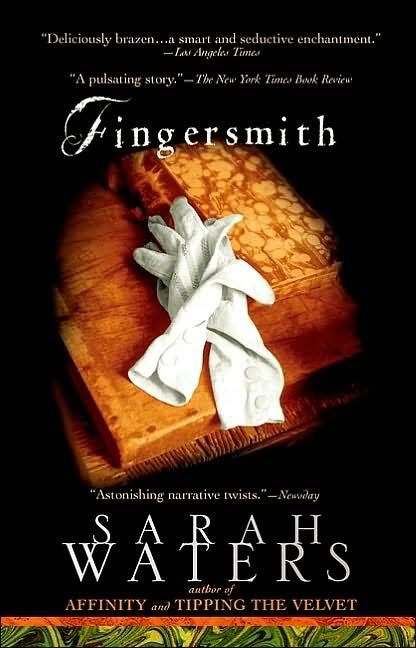
ARCHIVED REVIEW: Fingersmith (8/3/11)


Fingersmith
by Sarah Waters

"All day I sat or walked with her, so full of the fate I was bringing her to I could hardly touch her or meet her gaze; and all night I lay with my back turned to her, the blanket over my ears to keep out her sighs. But in the hours in between, when she went to her uncle, I felt her—I felt her, through the walls of the house, like some blind crooks are said to be able to feel gold. It was as if there had come between us, without my knowing, a kind of thread. It pulled me to her, wherever she was."

Susan, a girl raised among thieves in dirty Dickensian London, is sent disguised as a lady's maid to a cavernous, decaying mansion to woo an innocent, fragile, dowry-full maiden for a rogue known as the Gentleman and help him steal her fortune. She thinks the money is worth it, but all is not as it seems.

This book was excellent! The structure was a strange, measured waltz for two women: the story begins from Susan's point of view, and then, with a dramatic and always unexpected plot twist, the narrative jumps to the other girl. Each time, the same series of events is retold, and everything you assumed was truth is turned on its head. You are constantly on the edge of your seat, wondering what sudden twist the story will take next and how it will all end.

Waters has an incredible eye for detail, and understands how one gesture or sigh can be grossly misinterpreted depending on who you are and where you are standing.

The two tales braid together in a story of treachery, madness, murder, duality, and desire.

And yes, there is lesbian love. It is a lesbian Victorian Dickensian lovefest. Though not as much as I had expected, mostly unrequited passion. What sex scenes there are are beautifully emotional and sensual, rather than sordid, voyeuristic or graphic.

Very well-written, and not a word was wasted. I definitely recommend it to anyone who loves the Victorian Era's underbelly like I do.

If you liked this book, you may like:
The Devil in the White City by Erik Larson

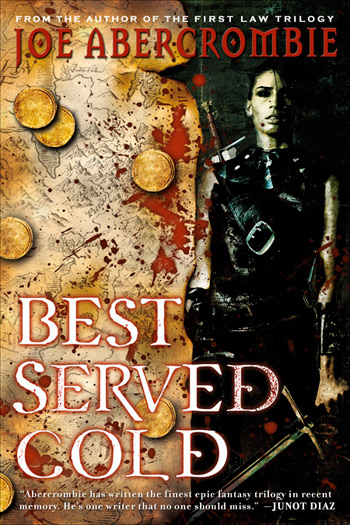
ARCHIVED REVIEW: Best Served Cold (2/6/11)


Best Served Cold
by Joe Abercrombie

"You were a hero round these parts. That's what they call you when you kill so many people the word murderer falls short." 
— Joe Abercrombie (Best Served Cold)

After being chucked off a balcony to her (supposed) death, Monza Murcatto swears revenge on the seven men who put her there. Along the way she gathers a rag-tag band of the usual morally vague mercenaries: a self-aggrandizing poisoner and his doll-faced apprentice, an OCD thug, a foppish old enemy/friend and expert swordsman, Vitari the redheaded torturer from the First Law series, and Shivers, the Northman who is trying to be a better man, but still needs to eat. They cut a bloody swath through Styria as each of Monza's murderers fall prey to her wrath. But revenge is not as fulfilling as Monza thought.

This book is not as complex as his first trilogy, but then again, he is trying to fit a story arc into one book instead of three. It took me a while to get invested, and due to the episodic nature of the book (a section per kill) I found certain sections lost my interest.

That being said, this was yet another fantastic book! Monza and Shiver's cross character development was incredibly compelling: as one was crawling tentatively up the morality scale, the other was sliding steadily down. And again, Joe Abercombie continues to create unexpected characters, for example, the monosyllabic, OCD thug who must compulsively count everything, lives his life by what number he rolls on his dice, and wants nothing more than to go back to the rigid schedule of prison.

When it comes to violence, there is no man better than Abercrombie. His training in film editing creates incredibly clear and morbidly creative fight scenes. I started to really pay attention starting with the macabre, Mardi-Gras-like slaughter at an upscale brothel.

He is also the master of plot twists. Just when you think you know the story formula, he turns the outcome on its head. Even when you think you've got Abercrombie's tricks down, he changes tactics. He then subtly drops plot hints like bread crumbs and the suspense is generated while you are waiting for the characters to realize what you have already seized upon. He creates moments where both Monza and the reader wishes to grant mercy, but he relentlessly serves the story alone, and gives no quarter.

Oddly enough, Joe Abercrombie at last gives the reader what passes in this world as a happy ending (compared to the ending of the First Law). The same ambiguity shrouds the denouement of this book as the other, but there is hope for redemption and change for good, rather than the threat of corruption. And a new player enters the game to potentially turn the tables on the evil done in the First Law Trilogy.

I definitely recommended it for those who love dark, gritty fantasy, or those who are bored with the hearts-and-flowers, "the good guys win and we all learn something uplifting about the world," done-to-death plots.