Showing posts with label spiritual. Show all posts

Wednesday, October 12, 2011

ARCHIVED REVIEW: The Napoleon of Notting Hill (11/11/10)


The Napoleon of Notting Hill
by G.K. Chesterton

It is 1980 (the future) but everything is pretty much the same as at the turn of the century. Everything has become more gray, more normal, and the king is chosen through alphabetical order, since it is just as good as through birth.

In this humorless world lives Auberon Quin, a satirist, who thinks everything is funny. When he is chosen to be king, he decides to turn the world on its head. He draws up a proclamation, separating London into her different burroughs, making them walled cities, and commanding the Provosts of those cities to wear garish medieval garb, speak in high romantic language, and be followed around everywhere by trumpeters and halbriders.

Then, he meets the one Provost who takes it seriously. Adam Wayne sees romance in everything, everything is significant and glorious. Adam believes this so passionately that he starts a war over a road that will go through his neighborhood.

I loved this book so much! The entire book is an extended parable, examining those who don't take life seriously, and those who take even a lamppost deadly seriously. I was intrigued because I never knew which side G.K. Chesterton was on. He let each side speak their piece.

My favorite moment in the book involves Adam Wayne recruiting for his army and he goes into a succession of shops. The first is a grocer, and instead of seeing a plain grocer, he sees a purveyor of exotic goods from all over the world, and recommends he organize his shop by country, decking each display with silks and incense and artifacts from the country. He sees the chemist (pharmacist) as a dark, benevolent sorcerer, with a shop full of strange vials and colorful liquids.

He sees the ordinary as extraordinary, and by the end of the book, he has changed the world.

If you liked this book, you may also like:

ARCHIVED REVIEW: The Man Who Was Thursday (10/29/10)


The Man Who Was Thursday
by G.K. Chesterton

After a heated, but supposedly theoretical, debate about anarchism at an evening garden party, poet Gregory Syme finds himself leaping headlong into an dangerous mission to infiltrate the powerful anarchist cell in the city. But nothing is as it seems.

I loved this book! Every time I thought I knew what was going on, GK threw a curve ball at me. And even when I discovered what was going on before it happened, it was still a delight to watch it unfold. It gets a bit allegorical, but it is so beautiful and satisfying that I didn't really care.

And GK's writing is incredibly Neil Gaimany, especially in his character descriptions of the anarchist council. Its like a Sandman pantheon. I can see how Neil was influenced by GK.

If you liked this book, you may also like:

ARCHIVED REIVIEW: Essential Writings of G.K. Chesterton (10/21/10)

Essential Writings of G.K. Chesterton
Edited by William Griffin

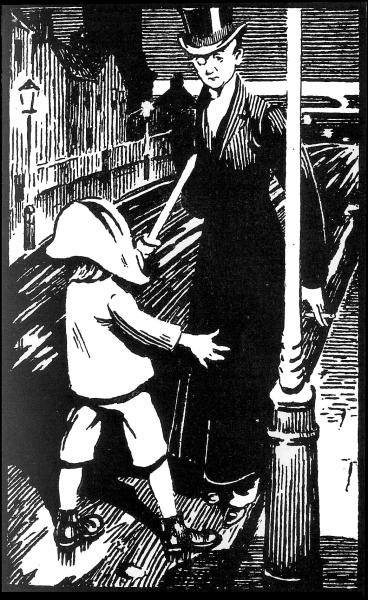
(the cover of the book is boring, so here is a fun caricature of GK).

This book is a collection of G.K. Chesterton's non-fictional writing on philosophy, social commentary and religion.

With this book, I have fallen in love with GK Chesterton: the man, if not the writer. He was an enormous man, with a fat walrus mustache. He dressed so shabbily that his wife dressed him in an opera cape, strange hat and a sword cane so that people wouldn't notice his shabby clothes because of the eccentricity of his dress. He ate a lot, drank a lot, and was merry a lot. He was jovial and generous, very spiritual, and yet not afraid to live in this world to the fullest. He valued Humor and Humility above all things, loved a good joke, and reveled in paradox.

All of this is revealed throughout his writing. In one essay, he expounds upon the luckiness of a man who thinks he has discovered a new land, but realizes upon arrival that he has sailed back to England. He gets both things that man needs most: the uncertainty and excitement of adventure and wonder, and the cozy stability of home. In another, he talks about how you should love the world for all its gladness, and if it is sad, you should then love it more. In another, he expounds upon how a child sees a tree and a lamp post with equal wonder, and how we should retain that wonder at every day life as we grow up. He talks about how the spiritual man is the only sane man, because he can see the smaller and the larger picture by the light of his belief, that virtue is not the absence of vice, but a "vivid and separate thing, like pain or a particular smell." He wrote a series of essays entitled, "Why I am Not a Pagan," "Why I am a Christian," "Why I am a Catholic," "Why I am an Elf," and "Why I am a Clown." He talks about the silence of the universe being not emptiness, but mercy, because if we could hear the laughter of the heavens and experience the "frantic energy of divine things" we would be knocked down "like a drunken farce."

You see why I love him.

His writing does get convoluted at times, and his logic often does not follow. He runs very much on emotion and humor to get his point across, and you can very easily poke holes in some of his arguments. (There is a debate between GK and GBS at the end of the book, and this is extremely apparent when juxtaposing their styles of argument). However, I don't think he cares. He feels something, and wants to tell you why he feels that way. More often than not it is just because it is beautiful or awe inspiring, not because it is logical.

If you liked this book, you may also like:
The Napoleon of Notting Hill by G. K. Chesterton
The Man Who Was Thursday

ARCHIVED REVIEW: Eat, Pray, Love (5/12/10)


Eat, Pray, Love
By Elizabeth Gilbert

"As I focus on diligent joy, I also keep remembering a simple idea my friend Darcey told me once -- that all the sorrow and trouble of this world is caused by unhappy people. Not only in the big global Hitler-'n'-Stalin picture, but also on the smallest personal level. Even in my own life, I can see exactly where my episodes of unhappiness have brought suffering or distress or (at the very least) inconvenience to those around me. The search for contentment is, therefore, not merely a self-preserving and self-benefiting act, but also a generous gift to the world. Clearing out all your misery gets you out of the way. You cease being an obstacle, not only to yourself but to anyone else. Only then are you free to serve and enjoy other people." — Elizabeth Gilbert 
(Eat, Pray, Love: One Woman's Search for Everything Across Italy, India and Indonesia)

This is a memoir of Liz Gilbert, a 34 year old woman who just suffered through a horrific and drawn out divorce, and then an intense relationship with a rebound guy. She realizes she has never been on her own, she has always clung to a man, and so she embarks on a voyage of self-discovery. She explores pleasure (mostly in the form of food) in Italy, prayer and meditation in an Ashram in India, and balance and love in Bali.

So I went into this book thinking I was going to hate it. We read it for book club and I thought it was going to be vapid and self-indulgent. But I was actually very touched and impressed by it. I was a bit annoyed with Liz at the beginning whenever she expressed her depression, but I believe it was partially because I often felt the same way, but didn't want to recognize it in myself. So it was easy to be all judgey-judge outside of the pain, rather than mid-pain, when it is easy to sink into a mire of malaise. The descriptions of the pain and confusion she felt were a great advantage to the book, however, because she let the story run its course: she was in pain when she felt pain, and she was transcendent when she was transcendent. It allowed her a complete journey without "oh if I had known this meditation when I was feeling this pain I could have blah blah blah."

Because I had a hard time letting myself relate to her when she was in pain, I reveled in her descriptions of other people. She has a gift for making characters jump off the page with a few crisp well chosen words. I also loved the historical and cultural tidbits that she stuffed in the corners of her narrative, like how the Italian language we know today was chosen as "official" Italian because it was the dialect of Dante's Inferno, and the most beautiful of the options. Or what the hell an Ashram is and the different types of meditation. Or just how awesome Bali is.

And the wisdom that she gleaned from this journey rang true with me almost every time. I kept having moments of "omg I never realized that!" And the grace that she worked her ass off for inspired me every time.

I admire the sheer tenacity of this woman who took a year off (granted she had the money) and committed not to this decadent vacation, which is what I thought it would be, but to a rigorous, and often grueling quest for happiness.

I recommend it to all women who are unhappy with their lives, so you can be inspired to find a (less expensive) way to seek that solid core of happiness that everyone deserves, and those who are happy with their lives so that you can sit back and appreciate the happy.

If you liked this book, you may like:
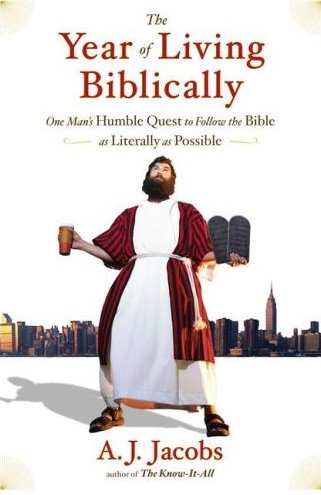
A Year of Living Biblically by A.J. Jacobs

ARCHIVED REVIEW: The Year of Living Biblically (4/10/10)

(All archived reviews are from a previous book blog journal)


The Year of Living Biblically: 
One Man's Humble Quest to Follow the Bible as Literally as Possible
 By A.J. Jacobs. 

This is a wonderful story about a man's quest to discover what this religion thing is all about.

He decides to follow all the rules set out in the bible, even the really crazy ones, like stealing eggs from pigeons. Sometimes, the rules don't really affect him, but sometimes they change him in the most profound way. Like the rule in the bible about how you must always wear white. It makes him feel lighter, and happier. More spiritual.

I also learned so much about Jewish traditions, and the reason behind them. I always thought it was sexist to call women unclean during their period, but when a woman bleeds it is considered a little death. The loss of a potential life. And apparently there is a similar one for men too, but no one talks about it that much.

It is so admirable how he commits to the project, even to the inconvenience of his family. (The interplay between himself and his wife is one of the real delights of the book.)

He starts out not believing, but knowing that if he goes through the motions of the traditions, he might end up believing.

He comes out the other side a "reverent agnostic," he says. Paying attention to all the rules, resting on the sabbath, obeying laws, giving thanks, made him pay more attention to life. To the tiny every day things. 

When learning the different ways to pray, he says thanks over his hummus: "I'd like to thank the farmer who grew the chickpeas for this hummus. And the truckers who drove them to the store. And the little old Italian Lady who sold the hummus to me at Zingone's deli and told me 'Lots of Love.'" It sounded silly, but made him really pay attention to the food he was eating, and made him feel connected to all those people.

He gained so much from the different traditions he examined: Amish, Hasidic Jew, Red-Letter Christian, Snake Handers, Jerry Fallwell's parish, and the philosophy of his various spiritual advisors, like the "pastor out to pasture."

He gains a small bit of meaning from even the strangest traditions. He learned how to surrender, he broke down religious stereotypes, and learned how to live in each moment, giving thanks.

I recommend it to anyone of any religion, or no religion.